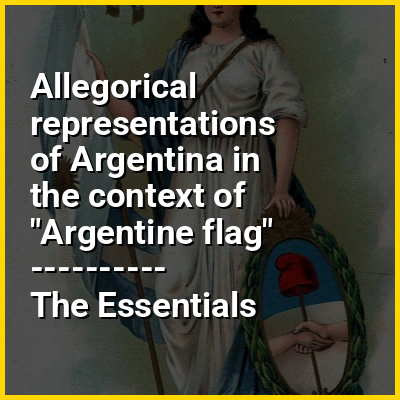
There are various allegorical representations of Argentina or associated in any way with Argentina. There is not, however, a national personification with its own name, like Marianne from France, or Hispania from Spain, but sculptures and engravings representing liberty, republic, motherland or other concepts that have been used officially by the Argentine state. The allegory is represented in most cases by a young woman called the Liberty of Oudiné, dressed in a kind of tunic, with a light skin and flowing brown or black wavy hair. She usually wears a red Phrygian cap, an emblem of liberty. When the allegory of Argentina is depicted, her tunic and overtunic almost always bear the colors of the Argentine flag.
HINT:
In this Dossier
- ⭐ Core Definition: Allegorical representations of Argentina
- Allegorical representations of Argentina in the context of Argentine Declaration of Independence
Allegorical representations of Argentina in the context of Argentine Declaration of Independence
The Independence of the Argentine Republic (or La Independencia de Argentina in Spanish) was declared on July 9, 1816, by the Congress of Tucumán. In reality, the congressmen who were assembled in Tucumán declared the independence of the United Provinces of South America, which is one of the official names of the Argentine Republic. The Federal League Provinces, at war with the United Provinces, were not allowed into the Congress. At the same time, several provinces from the Upper Peru that would later become part of present-day Bolivia, were represented at the Congress.
View the full Wikipedia page for Argentine Declaration of Independence