All Saints' Church, Wittenberg in the context of "Wittenberg"

Play Trivia Questions online!

or

Skip to study material about All Saints' Church, Wittenberg in the context of "Wittenberg"

Ad spacer

⭐ Core Definition: All Saints' Church, Wittenberg

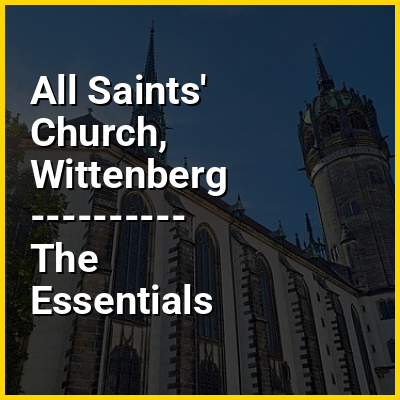
All Saints' Church, commonly referred to as Schlosskirche (Castle Church) to distinguish it from the Stadtkirche (Town Church) of St. Mary's, sometimes known as the Reformation Memorial Church, is a Lutheran church in Wittenberg, Saxony-Anhalt, Germany. It is the site where, according to Philip Melanchthon, the Ninety-five Theses were posted by Martin Luther in 1517, launching the beginning of the Protestant Reformation.

Beginning in 1883, the church was restored as a memorial site and re-inaugurated on 31 October 1892, 375 years after Luther's posting. Because of its religious significance and testimony to the lasting global effects of the Reformation, the church was inscribed on the UNESCO World Heritage List in 1996 along with other sites in Wittenberg and Eisleben associated with Martin Luther and Philip Melanchthon.
↓ Menu

>>>PUT SHARE BUTTONS HERE<<<
In this Dossier

All Saints' Church, Wittenberg in the context of Protestantism

Protestantism is a branch of Christianity that emphasizes justification of sinners through faith alone, the teaching that salvation comes by unmerited divine grace, the priesthood of all believers, and the Bible as the sole infallible source of authority for Christian faith and practice. The five solae summarize the basic theological beliefs of mainstream Protestantism.

Protestants follow the theological tenets of the Protestant Reformation, a movement that began in the 16th century with the goal of reforming the Catholic Church from perceived errors, abuses, and discrepancies. The Reformation began in the Holy Roman Empire in 1517, when Martin Luther published his Ninety-five Theses as a reaction against abuses in the sale of indulgences by the Catholic Church, which purported to offer the remission of the temporal punishment of sins to their purchasers. Luther's statements questioned the Catholic Church's role as negotiator between people and God, especially when it came to the indulgence arrangement, which in part granted people the power to purchase a certificate of pardon for the penalization of their sins. Luther argued against the practice of buying or earning forgiveness, claiming instead that salvation is a gift God gives to those who have faith.

↑ Return to Menu

All Saints' Church, Wittenberg in the context of Stadtkirche Wittenberg

The Stadt- und Pfarrkirche St. Marien zu Wittenberg (Town and Parish Church of St. Mary's) is the civic church of the German town of Lutherstadt Wittenberg. The reformers Martin Luther and Johannes Bugenhagen preached there and the building also saw the first celebration of the mass in German rather than Latin and the first ever distribution of the bread and wine to the congregation – it is thus considered the mother-church of the Protestant Reformation. In 1996, it was inscribed on the UNESCO World Heritage List along with Castle Church of All Saints (Schlosskirche), the Lutherhaus, the Melanchthonhaus, and Martin Luther's birth house and death house in Eisleben, because of its religious significance and testimony to the lasting, global influence of Protestantism.

↑ Return to Menu