Al Qawasim in the context of "Emirate of Sharjah"

Play Trivia Questions online!

or

Skip to study material about Al Qawasim in the context of "Emirate of Sharjah"

Ad spacer

⭐ Core Definition: Al Qawasim

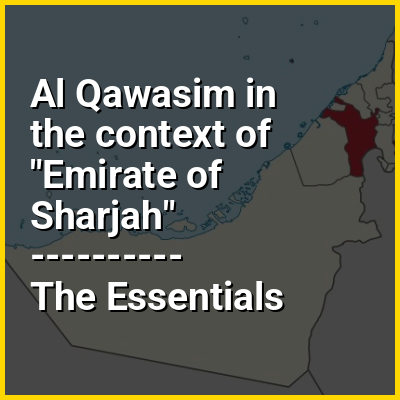
The Al Qasimi (Arabic: القاسمي, spelled sometimes as Al Qassimi or Al Qassemi; plural: Al Qawasem Arabic: القواسم and, archaically, Joasmee) is an Arab dynasty and tribe that rules Sharjah and Ras Al Khaimah, today forming two of the seven emirates of the United Arab Emirates. They are one of the longest reigning royal families in the Arabian peninsula. Historically, they also ruled over the town of Lengeh as sheikhs for a century until its annexation by Iran in 1887.

The Qawasem were a confederation of Sunni tribes in south eastern Gulf region surrounding the cities of Ras Al Khaimah and Sharjah; and faced strong rivalry with the Omani empire for naval domination along the Persian Gulf. Due to their allegiance to the Emirate of Dir'iyah, the British Empire branded them as "pirates" and fought two major military campaigns against them in 1809 and 1819.
↓ Menu

>>>PUT SHARE BUTTONS HERE<<<
In this Dossier

Al Qawasim in the context of Piracy in the Persian Gulf

Piracy in the Persian Gulf describes the naval warfare that was prevalent until the 19th century and occurred between seafaring Arabs in Eastern Arabia and the British Empire in the Persian Gulf. It was perceived as one of the primary threats to global maritime trade routes, particularly those with significance to British India and Iraq. Many of the most notable historical instances of these raids were conducted by the Al Qasimi tribe. This led to the British mounting the Persian Gulf campaign of 1809, a major maritime action launched by the Royal Navy to bombard Ras Al Khaimah, Lingeh and other Al Qasimi ports. Some critics of the historical narrative, such as Sharjah ruler Sultan bin Muhammad Al Qasimi in his book The Myth of Piracy in the Gulf, argue that the allegations of piracy were exaggerated by the East India Company to cut off untaxed trade routes between the Middle East and India.

Piratical activities were common in the Persian Gulf from the late 18th century to the mid-19th century, particularly in the area known as the Pirate Coast which spanned from modern-day Qatar to Oman. Piracy was alleviated from 1820 with the signing of the General Maritime Treaty, cemented in 1853 by the Perpetual Maritime Truce, after which the Pirate Coast began to be known by the British as the Trucial Coast (present-day United Arab Emirates).

↑ Return to Menu