Air parcel in the context of "Atmospheric convection"

Play Trivia Questions online!

or

Skip to study material about Air parcel in the context of "Atmospheric convection"

Ad spacer

⭐ Core Definition: Air parcel

In fluid dynamics, a fluid parcel, also known as a fluid element or material element, is an infinitesimal volume of fluid, identifiable throughout its dynamic history while moving with the fluid flow. As it moves, the mass of a fluid parcel remains constant, while—in a compressible flow—its volume may change, and its shape changes due to distortion by the flow. In an incompressible flow, the volume of the fluid parcel is also a constant (isochoric flow).

Material surfaces and material lines are the corresponding notions for surfaces and lines, respectively.

↓ Menu

>>>PUT SHARE BUTTONS HERE<<<
In this Dossier

Air parcel in the context of Atmospheric instability

Atmospheric instability is a condition where the Earth's atmosphere is considered to be unstable and as a result local weather is highly variable through distance and time. Atmospheric instability encourages vertical motion, which is directly correlated to different types of weather systems and their severity. For example, under unstable conditions, a lifted parcel of air will find cooler and denser surrounding air, making the parcel prone to further ascent, in a positive feedback loop.

In meteorology, instability can be described by various indices such as the Bulk Richardson Number, lifted index, K-index, convective available potential energy (CAPE), the Showalter, and the Vertical totals. These indices, as well as atmospheric instability itself, involve temperature changes through the troposphere with height, or lapse rate.

↑ Return to Menu

Air parcel in the context of Moist convection

Atmospheric convection is the vertical transport of heat and moisture in the atmosphere. It occurs when warmer, less dense air rises, while cooler, denser air sinks.

This process is driven by parcel-environment instability, meaning that a "parcel" of air is warmer and less dense than the surrounding environment at the same altitude. This difference in temperature and density (and sometimes humidity) causes the parcel to rise, a process known as buoyancy. This rising air, along with the compensating sinking air, leads to mixing, which in turn expands the height of the planetary boundary layer (PBL), the lowest part of the atmosphere directly influenced by the Earth's surface. This expansion contributes to increased winds, cumulus cloud development, and decreased surface dew points (the temperature below which condensation occurs).

↑ Return to Menu

Air parcel in the context of Lifted index

The lifted index (LI) is the temperature difference between the environment Te(p) and an air parcel lifted adiabatically Tp(p) at a given pressure height in the troposphere (lowest layer where most weather occurs) of the atmosphere, usually 500 hPa (mb). The temperature is measured in Celsius. When the value is positive, the atmosphere (at the respective height) is stable and when the value is negative, the atmosphere is unstable.

↑ Return to Menu

Air parcel in the context of Convective available potential energy

In meteorology, convective available potential energy (commonly abbreviated as CAPE), is a measure of the capacity of the atmosphere to support upward air movement that can lead to cloud formation and storms. Some atmospheric conditions, such as very warm, moist, air in an atmosphere that cools rapidly with height, can promote strong and sustained upward air movement, possibly stimulating the formation of cumulus clouds or cumulonimbus (thunderstorm) clouds. In that situation the potential energy of the atmosphere to cause upward air movement is very high, so CAPE (a measure of potential energy) would be high and positive. By contrast, other conditions, such as a less warm air parcel or a parcel in an atmosphere with a temperature inversion (in which the temperature increases above a certain height) have much less capacity to support vigorous upward air movement, thus the potential energy level (CAPE) would be much lower, as would the probability of thunderstorms.

More technically, CAPE is the integrated amount of work that the upward (positive) buoyancy force would perform on a given mass of air (called an air parcel) if it rose vertically through the entire atmosphere. Positive CAPE will cause the air parcel to rise, while negative CAPE will cause the air parcel to sink. Nonzero CAPE is an indicator of atmospheric instability in any given atmospheric sounding, a necessary condition for the development of cumulus and cumulonimbus clouds with attendant severe weather hazards.

↑ Return to Menu

Air parcel in the context of Potential temperature

The potential temperature of a parcel of fluid at pressure is the temperature that the parcel would attain if adiabatically brought to a standard reference pressure , usually 1,000 hPa (1,000 mb). The potential temperature is denoted and, for a gas well-approximated as ideal, is given by

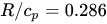
where is the current absolute temperature (in K) of the parcel, is the specific gas constant of air, and is the specific heat capacity at a constant pressure. for air (meteorology). The reference point for potential temperature in the ocean is usually at the ocean's surface which has a water pressure of 0 dbar. The potential temperature in the ocean doesn't account for the varying heat capacities of seawater, therefore it is not a conservative measure of heat content. Graphical representation of potential temperature will always be less than the actual temperature line in a temperature vs depth graph.

↑ Return to Menu

Air parcel in the context of Potential vorticity

In fluid mechanics, potential vorticity (PV) is a quantity which is proportional to the dot product of vorticity and stratification. This quantity, following a parcel of air or water, can only be changed by diabatic or frictional processes. It is a useful concept for understanding the generation of vorticity in cyclogenesis (the formation and development of a cyclone), especially along the polar front, and in analyzing flow in the ocean.

Potential vorticity (PV) is seen as one of the important theoretical successes of modern meteorology. It is a simplified approach for understanding fluid motions in a rotating system such as the Earth's atmosphere and ocean. Its development traces back to the circulation theorem by Bjerknes in 1898, which is a specialized form of Kelvin's circulation theorem. Starting from Hoskins et al., 1985, PV has been more commonly used in operational weather diagnosis such as tracing dynamics of air parcels and inverting for the full flow field. Even after detailed numerical weather forecasts on finer scales were made possible by increases in computational power, the PV view is still used in academia and routine weather forecasts, shedding light on the synoptic scale features for forecasters and researchers.

↑ Return to Menu