Agha Mohammad Khan Qajar in the context of "Afsharid Iran"

Play Trivia Questions online!

or

Skip to study material about Agha Mohammad Khan Qajar in the context of "Afsharid Iran"

Ad spacer

⭐ Core Definition: Agha Mohammad Khan Qajar

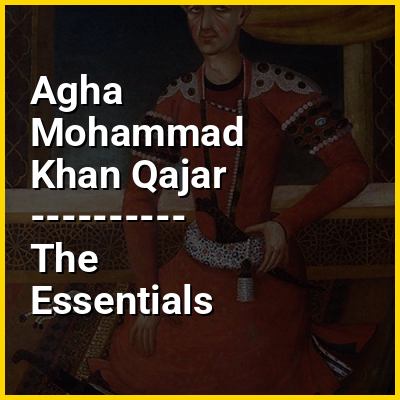
Agha Mohammad Khan Qajar (Persian: آقامحمدخان قاجار, romanizedÂqâ Mohammad Xân-e Qâjâr; 14 March 1742 – 17 June 1797), also known by his regnal name of Agha Mohammad Shah (آقامحمد شاه), was the founder of the Qajar dynasty of Iran, ruling as Shah from 1789 to 1797. Originally a chieftain of the Quwanlu branch of the Qajar tribe, Agha Mohammad Khan was enthroned as the king of Iran in 1789 and crowned shāhanshāh (“King of Kings”) in 1796, after leading the Unification of Iran (1779–1796). Agha Mohammad Khan is often renowned as a "shrewd and relentless" leader whose "iron will" and military campaigns were pivotal in the establishment of present-day Iran.

Agha Mohammad Khan Qajar was castrated as a toddler upon his capture by Adel Shah Afshar and hence was childless. He was assassinated on 17 June 1797, and was succeeded by his nephew, Fath-Ali Shah Qajar.

↓ Menu

>>>PUT SHARE BUTTONS HERE<<<
In this Dossier

Agha Mohammad Khan Qajar in the context of Qajar Iran

The Guarded Domains of Iran, alternatively the Sublime State of Iran and commonly called Qajar Iran, Qajar Persia or the Qajar Empire, was the Iranian state under the rule of the Qajar dynasty, which was of Turkic origin, specifically from the Qajar tribe, from 1789 to 1925. The Qajar family played a pivotal role in the Unification of Iran (1779–1796), deposing Lotf 'Ali Khan, the last Shah of the Zand dynasty, and re-asserted Iranian sovereignty over large parts of the Caucasus. In 1796, Agha Mohammad Khan Qajar seized Mashhad with ease, putting an end to the Afsharid dynasty. He was formally crowned as Shah after his punitive campaign against Iran's Georgian subjects.

In the Caucasus, the Qajar dynasty permanently lost much territory to the Russian Empire over the course of the 19th century, comprising modern-day eastern Georgia, Dagestan, Azerbaijan, and Armenia. Despite its territorial losses, Qajar Iran reinvented the Iranian notion of kingship and maintained relative political independence, but faced major challenges to its sovereignty, predominantly from the Russian and British empires. Foreign advisers became powerbrokers in the court and military. They eventually partitioned Qajar Iran in the 1907 Anglo-Russian Convention, carving out Russian and British influence zones and a neutral zone.

↑ Return to Menu

Agha Mohammad Khan Qajar in the context of Tehran

Tehran is the capital and largest city of Iran. It is also the capital of Tehran province and the administrative center for Tehran County and its Central District. With a population of around 9 million in the city, and 15 million in the metropolitan area, Tehran is the most populous city in Iran and West Asia, the second largest metropolitan area in the Middle East after Cairo, and the 24th-most-populous metropolitan area in the world. Greater Tehran includes several municipalities, including but not limited to Karaj, Eslamshahr, Shahriar, Qods, Malard, Golestan, Pakdasht, Qarchak, Nasimshahr, Parand, Pardis, Andisheh and Fardis.

In classical antiquity, part of the territory of present-day Tehran was controlled by Rhages/Rey/Ray). Modern Ray was absorbed into the metropolitan area of Greater Tehran. Tehran was 1st chosen as the capital of Iran in 1786 by Agha Mohammad Khan of the Qajar dynasty, because of its proximity to Iran's territories in the Caucasus—which were contested in the Russo-Iranian Wars—and to avoid the vying factions of prior ruling Iranian dynasties; the capital of Iran had been moved several times throughout its long history, with Tehran becoming the 32nd. Under (1848-1896), Tehran witnessed Iran's first institute of higher learning, bank, railway line, and museum. Large-scale construction works began in the 1920s, and Tehran became a destination for mass migrations from all over Iran especially in the 20th century.

↑ Return to Menu

Agha Mohammad Khan Qajar in the context of Qajar dynasty

The Qajar dynasty (Persian: دودمان قاجار, romanizedDudemâne Ǧâjâr) is a formerly aristocratic (and from 1789-1925, royal) Iranian dynasty that gained prominence with the rise of Shahverdi Qajar in the early 16th century as heads of the Turkoman Qajar tribe of the Qizilbash confederacy. The dynasty ruled Iran from 1789 until 1925, upon the Unification of Iran (1779–1796) by Mohammad Khan Qajar (r. 1789–1797).

The Russian branch of the Qajar dynasty belonged to the Russian Nobility and were given the titles Prince Persidskii and Princess Persidskaya by the Tsar in the 19th century, of which many members had held high functions in the Imperial Russian Army, such as Aleksander Reza Qoli Mirza Qajar.

↑ Return to Menu

Agha Mohammad Khan Qajar in the context of Kingdom of Kartli-Kakheti

The Kingdom of Kartli-Kakheti (Georgian: ქართლ-კახეთის სამეფო, romanized: kartl-k'akhetis samepo) was created in 1762 by the unification of the two eastern Georgian kingdoms of Kartli and Kakheti. From the early 16th century, according to the 1555 Peace of Amasya, these two kingdoms were under Iranian control. In 1744, Nader Shah granted the kingship of Kartli to Teimuraz II and that of Kakheti to his son Heraclius II, as a reward for their loyalty. When Nader Shah died in 1747, Teimuraz II and Heraclius II capitalized on the instability in Iran proper, and declared de facto independence. After Teimuraz II died in 1762, Heraclius succeeded him as ruler of Kartli, thus unifying the two kingdoms.

Heraclius was able, after centuries of Iranian suzerainty over Georgia, to guarantee the autonomy of his kingdom throughout the chaos that had erupted following Nader Shah's death. He became the new Georgian king of a politically united eastern Georgia for the first time in three centuries. Though Heraclius tendered his de jure submission to the newly established Zand dynasty quickly after the unification in 1762, the kingdom remained de facto autonomous for the next three decades to come. In 1783, Heraclius signed the Treaty of Georgievsk with the Russian Empire, by which he formally laid Kartli-Kakheti's investiture in the hands of the Russian monarch, and made the kingdom a Russian protectorate. Amongst others, this provided the nominal guarantee for protection against new Iranian attempts, or by any others, to (re)conquer or attack eastern Georgia. By the 1790s, a new strong Iranian dynasty, the Qajar dynasty, had emerged under Agha Mohammad Khan Qajar, which would prove pivotal in the history of the short-lived kingdom.
↑ Return to Menu

Agha Mohammad Khan Qajar in the context of Zand dynasty

The Zand dynasty (Persian: دودمان زندیان, romanizedDudemāne Zandiyān) was an Iranian dynasty, founded by Karim Khan Zand (r.1751–1779) that initially ruled southern and central Iran in the 18th century. It later expanded to include much of the rest of contemporary Iran (except for the provinces of Baluchestan and Khorasan) as well as parts of Iraq. The lands of present-day Armenia, Azerbaijan, and Georgia were controlled by khanates which were de jure part of the Zand realm, but the region was de facto autonomous. The island of Bahrain was also held for the Zands by the autonomous Al-Mazkur sheikhdom of Bushehr.

The reign of its most important ruler, Karim Khan, was marked by prosperity and peace. With its capital at Shiraz, arts and architecture flourished under Karim Khan's reign, with some themes in architecture being revived from nearby sites of pre-Islamic Achaemenid (550–330 BC) and Sasanian (224–651 AD) eras. The tombs of the medieval Persian poets Hafez and Saadi Shirazi were also renovated by Karim Khan. Distinctive Zand art which was produced at the behest of the Zand rulers became the foundation of later Qajar arts and crafts. Following Karim Khan's death, Zand Iran went into decline due to internal disputes amongst members of the Zand dynasty. Its final ruler, Lotf Ali Khan Zand (r.1789–1794), was eventually executed by Agha Mohammad Khan Qajar (r.1789–1797) in 1794.

↑ Return to Menu

Agha Mohammad Khan Qajar in the context of Battle of Krtsanisi

The Battle of Krtsanisi (Georgian: კრწანისის ბრძოლა, romanized: k'rts'anisis brdzola, Persian: نبرد کرتسانیسی) was fought between the army of Qajar Iran (Persia) and the Georgian armies of the Kingdom of Kartli-Kakheti and Kingdom of Imereti at the place of Krtsanisi near Tbilisi, Georgia, from September 8 to September 11, 1795, as part of Agha Mohammad Khan Qajar's war in response to King Heraclius II of Georgia’s alliance with the Russian Empire. The battle resulted in the decisive defeat of the Georgians, capture, and complete destruction of their capital Tbilisi, as well as the temporary absorption of eastern Georgia into the Iranian empire.

Although the Russian Empire had officially declared in the Treaty of Georgievsk of 1783 that it would protect Heraclius's kingdom against any Iranian attempts to re-subjugate Georgia, Russia did not intervene to protect its ally. Subsequently, in order to restore Russian prestige, Catherine the Great launched a punitive campaign against Iran in 1796, but it was soon recalled after Catherine's death the same year. The reestablishment of Iranian rule over Georgia did not last long, for the shah was assassinated in 1797 in Shusha, and the Georgian king died the year after. With Georgia laying in ruins and the central authorities in Iran occupied with the question of succession, the way was opened for Georgia's annexation by Russia several years later by Tsar Paul.

↑ Return to Menu

Agha Mohammad Khan Qajar in the context of Erivan Khanate

The Erivan Khanate (Persian: خانات ایروان, romanizedKhānāt-e Iravān), also known as Chokhur-e Sa'd, was a khanate (i.e., province) that was established in Afsharid Iran in the 18th century. It covered an area of roughly 19,500 km, and corresponded to most of present-day central Armenia, the Iğdır Province and the Kars Province's Kağızman district in present-day Turkey and the Sharur and Sadarak districts of the Nakhchivan Autonomous Republic of present-day Azerbaijan.

Following the death of Nader Shah in 1747, Iranian authority over the territories north of the Aras River was greatly weakened, and the Erivan Khanate became a tributary of King Heraclius II of Georgia. This arrangement persisted after Karim Khan Zand nominally restored Iranian authority in the South Caucasus. The Georgian king attacked the khanate multiple times when the khan attempted to avoid paying tribute. Like some of the other khans of the Caucasus, Mohammad Khan of Erivan sought to make contact with Russia after 1783, when Georgia became a Russian protectorate. In 1794–95, Agha Mohammad Khan Qajar campaigned to restore central authority in the region and received the submission of the khan of Erivan.

↑ Return to Menu