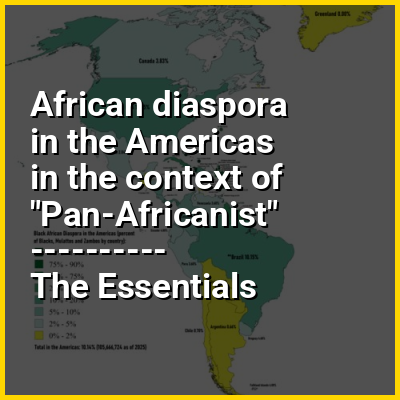
The African diaspora in the Americas refers to the people born in the Americas with partial, predominant, or complete sub-Saharan African ancestry. Many are descendants of persons enslaved in Africa and transferred to the Americas by Europeans, then forced to work mostly in European-owned mines and plantations, between the sixteenth and nineteenth centuries.Significant groups have been established in the United States (African Americans), in Canada (Black Canadians), in the Caribbean (Afro-Caribbean), and in Latin America (Afro-Latin Americans).
>>>PUT SHARE BUTTONS HERE<<<
In this Dossier
African diaspora in the Americas in the context of Pan-Africanism
Pan-Africanism is an ideology that aims to encourage and strengthen bonds of solidarity between all indigenous peoples of Africa along with all peoples of African descent. Based on a common goal dating back to the Atlantic slave trade, the Trans-Saharan slave trade, the Indian Ocean slave trade, the Red Sea slave trade, slavery in the Cape Colony, Inboekstelsel, slavery in Mauritius, and the Khoikhoi-Dutch Wars, the belief extends beyond continental Africans with a substantial support base among the African diaspora in the Americas and Europe.
Pan-Africanism is said to have its origins in the struggles of the sub-Saharan Africans against enslavement and colonization. This struggle may be traced back to the first resistance on slave ships, including rebellions and suicides, through the constant plantation and colonial uprisings and the "Back to Africa" movements of the 19th century. Based on the belief that unity is vital to economic, social, and political progress, it aims to unify and uplift people of African ancestry. However, it was in the twentieth century that Pan-Africanism emerged as a distinct political movement that was initially formed and led by people from the Diaspora (people of African heritage living outside of the Continent). In 1900, Henry Sylvester Williams, a Trinindadian barrister, called a conference that took place in London's Westminster Hall to "protest stealing of lands in the colonies, racial discrimination and deal with other issues of interest to Blacks".
African diaspora in the Americas in the context of Maroons
Africans in the Americas and islands of the Indian Ocean who escaped from slavery, through flight or manumission, and lived in independent settlements, were referred to as maroons in English, and as cimarrones in Spanish America. The English word "maroon" likely derives from the Spanish word "cimarron".
Maroon communities were a threat to plantation societies. It was difficult for colonial authorities to eradicate Maroon communities, because they were often hidden in remote environments. Maroons also frequently utilized guerrilla warfare to defend their settlements. This created a constant state of conflict with authorities, where Maroons would sometimes be used as allies by enemies attacking a colony. Sometimes, Maroons would also function as trading partners with remote settlers or Natives.