Africa Province in the context of "Fossa Regia"

Play Trivia Questions online!

or

Skip to study material about Africa Province in the context of "Fossa Regia"


⭐ Core Definition: Africa Province

Africa was a Roman province on the northern coast of the continent of Africa. It was established in 146 BC, following the Roman Republic's conquest of Carthage in the Third Punic War. It roughly comprised the territory of present-day Tunisia, the northeast of Algeria, and the coast of western Libya along the Gulf of Sidra. The territory was originally and still is inhabited by Berbers, known in Latin as the Numidae and Maurii, indigenous to all of North Africa west of Egypt. In the 9th century BC, Semitic-speaking Phoenicians from the Levant built coastal settlements across the Mediterranean to support and expand their shipping networks. In the 8th century BC, the settlement of Carthage became the predominant Phoenician colony. Rome began expanding into Africa after annexing Carthage in 146 BC at the end of the Punic Wars, and into Numidia from 25 BC, establishing Roman colonies in the region.

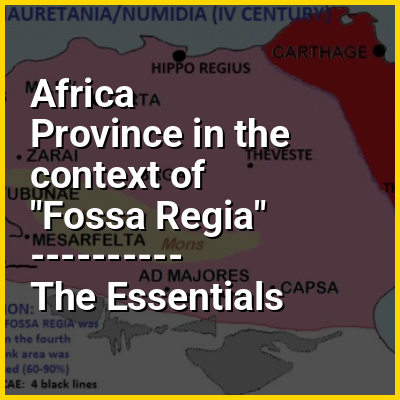
Africa was one of the wealthiest provinces in the Roman Empire, second only to Italy. It was said that Africa fed the Roman populace for eight months of the year, while Egypt provided the remaining four months' supply. The area east of the Fossa Regia was fully Romanized with one third of the population made of Italian colonists and their descendants, the other two thirds were Romanized Berbers, who were all Christians and nearly all Latin speaking.
↓ Menu

In this Dossier

Africa Province in the context of Siege of Carthage (Third Punic War)

The siege of Carthage was the main engagement of the Third Punic War fought between Carthage and Rome. It consisted of the nearly three-year siege of the Carthaginian capital, Carthage (a little northeast of Tunis). In 149 BC, a large Roman army landed at Utica in North Africa. The Carthaginians hoped to appease the Romans, but despite the Carthaginians surrendering all of their weapons, the Romans pressed on to besiege the city. The Roman campaign suffered repeated setbacks through 149 BC, only alleviated by Scipio Aemilianus, a middle-ranking officer, distinguishing himself several times. A new Roman commander took over in 148 BC, and fared equally badly. At the annual election of Roman magistrates in early 147 BC, the public support for Scipio was so great that the usual age restrictions were lifted to allow him to be appointed commander in Africa.

Scipio's term began with two Carthaginian successes, but he tightened the siege and commenced a construction of a large mole to prevent supplies from getting into Carthage via blockade runners. The Carthaginians had partially rebuilt their fleet and it sortied, to the Romans' surprise; after an indecisive engagement the Carthaginians mismanaged their withdrawal and lost many ships. The Romans then built a large brick structure in the harbour area, which dominated the city wall. In early 146BC the Romans launched their final assault, and over one week systematically destroyed the city and killed its inhabitants; only on the last day did they take prisoners – 50,000, who were sold into slavery. The formerly Carthaginian territories became the Roman province of Africa, with Utica as its capital. It was a century before the site of Carthage was rebuilt as a Roman city.

↑ Return to Menu

Africa Province in the context of Domitius Alexander

Lucius Domitius Alexander (died c. 310), probably born in Phrygia, was vicarius of Africa when Emperor Maxentius ordered him to send his son as hostage to Rome. Alexander refused and proclaimed himself emperor in 308.

The most detailed if somewhat confusing description of the insurrection is given by Zosimus (II, 12 and 14). He reports that Maxentius sent his portrait to Africa to gain recognition as Emperor there. The troops resisted because of their loyalty to Galerius. Maxentius ordered Domitius Alexander, the vicar of Africa, to send his son to Rome to secure his loyalty. Alexander refused and was crowned Emperor by his army. The incident was probably caused by the conflict between Maxentius and his father Maximian in April 308, and Zosimos confused Galerius with Maximian in his account.

↑ Return to Menu

Africa Province in the context of Magnus Maximus

Magnus Maximus (Classical Latin: [ˈmaːgnus ˈmaːksimus]; died 28 August 388) was Roman emperor in the West from 383 to 388. He usurped the throne from emperor Gratian.

Born in Gallaecia, he served as an officer in Britain under Theodosius the Elder during the Great Conspiracy. In 383, he was proclaimed emperor in Britannia, and in Gaul the next year, while Gratian's brother Valentinian II retained Italy, Pannonia, Hispania, and Africa. In 387, Maximus's ambitions led him to invade Italy, resulting in his defeat by Theodosius I at the Battle of Poetovio in 388. In the view of some historians, his death marked the end of direct imperial presence in Northern Gaul and Britannia.

↑ Return to Menu