Afanasievo culture in the context of Khakassia


Afanasievo culture in the context of Khakassia

⭐ Core Definition: Afanasievo culture

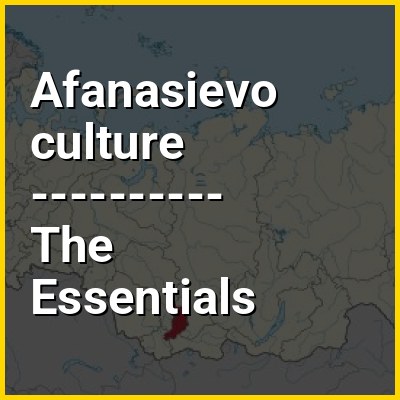
The Afanasievo culture, or Afanasevo culture (Afanasevan culture) (Russian: Афанасьевская культура Afanas'yevskaya kul'tura), is an early archaeological culture of south Siberia, occupying the Minusinsk Basin and the Altai Mountains during the eneolithic era, c. 3300 to 2500 BCE. It is named after a nearby mountain, Gora Afanasieva (Russian: Гора Афанасьева, lit.'Afanasiev's mountain') in what is now Bogradsky District, Khakassia, Russia, first excavated by archaeologist Sergei Teploukhov from 1920 to 1929. Afanasievo burials have been found as far as Shatar Chuluu in central Mongolia, confirming a further expansion about 1,500 km beyond the Altai Mountains. The Afanasievo culture is now considered an integral part of the Prehistory of Western and Central Mongolia.

According to David W. Anthony the Afanasevan population was descended from people who migrated c. 3700–3300 BCE across the Eurasian Steppe from the pre-Yamnaya Repin culture of the Don-Volga region. It is considered to be "intrusive from the west", in respect to previous local Siberian cultures. According to Anthony, "The Afanasievo culture migration to the Altai was carried out by people with a Repin-type material culture, probably from the middle Volga-Ural region."
↓ Menu
HINT:

In this Dossier

Afanasievo culture in the context of Kurgan hypothesis

The Kurgan hypothesis (also known as the Kurgan theory, Kurgan model, or steppe theory) is the most widely accepted proposal to identify the Proto-Indo-European homeland from which the Indo-European languages spread out throughout Europe and parts of Asia. It postulates that the people of a Kurgan culture in the Pontic steppe north of the Black Sea were the most likely speakers of the Proto-Indo-European language (PIE). The term is derived from the Turkic word kurgan (курга́н), meaning tumulus or burial mound.

The steppe theory was first formulated by Otto Schrader (1883) and V. Gordon Childe (1926), then systematized in the 1950s by Marija Gimbutas, who used the term to group various prehistoric cultures, including the Yamnaya (or Pit Grave) culture and its predecessors. In the 2000s, David Anthony instead used the core Yamnaya culture and its relationship with other cultures as a point of reference.

View the full Wikipedia page for Kurgan hypothesis
↑ Return to Menu

Afanasievo culture in the context of Tocharians

The Tocharians or Tokharians (US: /tˈkɛəriənˌ -ˈkɑːr-/ toh-KAIR-ee-ən, -⁠KAR-; UK: /tɒˈkɑːriən/ to-KAR-ee-ən) were speakers of the Tocharian languages, a group of Indo-European languages known from around 7,600 documents from the 6th and 7th centuries, found on the northern edge of the Tarim Basin (modern-day Xinjiang, China). The name "Tocharian" was given to these languages in the early 20th century by scholars who identified their speakers with a people known in ancient Greek sources as the Tókharoi (Latin: Tochari), who inhabited Bactria from the 2nd century BC. This identification is now generally considered erroneous, but the name "Tocharian" remains the most common term for the languages and their speakers. Their endonym is unknown, although they may have referred to themselves as the Agni, Kuči, and Krorän or as the Agniya and Kuchiya known from Sanskrit texts.

Agricultural communities first appeared in the oases of the northern Tarim circa 2000 BC. Some scholars have linked these communities to the Afanasievo culture found earlier (c. 3500–2500 BC) in Siberia, north of the Tarim or Central Asian BMAC culture. The earliest Tarim mummies date from c. 1800 BC, but it is unclear whether they are connected to the Tocharians of two millennia later. This once theorized ancestry between Tocharians and these mummies is however now largely considered to be discredited by the absence of a genetic connection with Indo-European-speaking migrants, particularly the Afanasievo or BMAC cultures.

View the full Wikipedia page for Tocharians
↑ Return to Menu

Afanasievo culture in the context of Tocharia

The Tocharians or Tokharians (US: /tˈkɛəriənˌ -ˈkɑːr-/ toh-KAIR-ee-ən, -⁠KAR-; UK: /tɒˈkɑːriən/ to-KAR-ee-ən) were speakers of the Tocharian languages, a group of Indo-European languages known from around 7,600 documents from the 6th and 7th centuries, found on the northern edge of the Tarim Basin (modern-day Xinjiang, China). The name "Tocharian" was given to these languages in the early 20th century by scholars who identified their speakers with a people known in ancient Greek sources as the Tókharoi (Latin: Tochari), who inhabited Bactria from the 2nd century BC. This identification is now generally considered erroneous, but the name "Tocharian" remains the most common term for the languages and their speakers. Their endonym is unknown, although they may have referred to themselves as the Agni, Kuči, and Krorän or as the Agniya and Kuchiya known from Sanskrit texts.

Agricultural communities first appeared in the oases of the northern Tarim circa 2000 BC, represented by the earliest Tarim mummies. Genetic analysis reveals that nearly all (11 of 12, ~92%) of the early Tarim males carried R1a1a-M198, with additional individuals carrying R1b1b, establishing them within the paternal lineages of Ancient North Eurasian (ANE, ~72%) ancestry. However, the early Tarim mummies were not direct ancestors of the later-attested Tocharians. Instead, the Tocharian languages were likely introduced to the Tarim Basin later by Afanasievo-related migrants from the central steppes carrying the exact same paternal R-M17 during the Late Bronze Age (1600–1400 BCE).

View the full Wikipedia page for Tocharia
↑ Return to Menu

Afanasievo culture in the context of Xianyun

The Xianyun (simplified Chinese: 猃狁; traditional Chinese: 獫狁, 玁狁; pinyin: Xiǎnyǔn; Wade–Giles: Hsien-yün; Old Chinese: (ZS) *g.ramʔ-lunʔ; (Schuessler) *hɨamᴮ-juinᴮ < *hŋamʔ-junʔ) was an ancient nomadic tribe that invaded the Zhou dynasty. This Chinese exonym is written with xian or "long-snouted dog", and this "dog" radical 犭 is commonly used in graphic pejorative characters. "Xianyun" was the preferred designation for northern tribes during the Zhou dynasty, earlier designations being the Xunyu, Guifang (Xia and Shang dynasties), and later ones being the Xiongnu, during the Han dynasty.

View the full Wikipedia page for Xianyun
↑ Return to Menu