Adolfo López Mateos in the context of 1958 Mexican general election


Adolfo López Mateos in the context of 1958 Mexican general election

⭐ Core Definition: Adolfo López Mateos

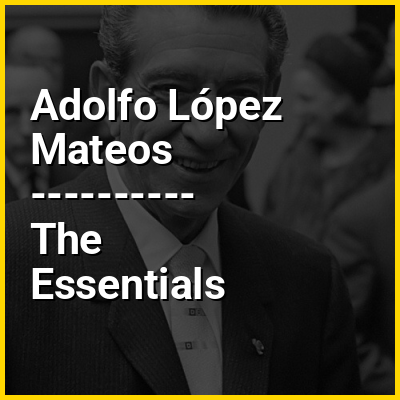
Adolfo López Mateos (Spanish pronunciation: [aˈðolfo ˈlopes maˈteos] ; 26 May 1909 – 22 September 1969) was a Mexican politician and lawyer who served as President of Mexico from 1958 to 1964. Previously, he served as Secretary of Labor and Social Welfare from 1952 to 1957 and a Senator from the State of Mexico from 1946 to 1952.

Beginning his political career as a campaign aide of José Vasconcelos during his run for president, López Mateos encountered repression from Plutarco Elías Calles, who attempted to maintain hegemony within the National Revolutionary Party (PNR). He briefly abandoned politics and worked as a professor at the Autonomous University of Mexico State, becoming a member of the PNR (renamed Party of the Mexican Revolution) in 1941. López Mateos served as senator for the State of Mexico from 1946 to 1952 and Secretary of Labor during the administration of Adolfo Ruiz Cortines from 1952 to 1957. He secured the party's presidential nomination and won in the 1958 general election.
↓ Menu
HINT:

👉 Adolfo López Mateos in the context of 1958 Mexican general election

General elections were held in Mexico on 6 July 1958. The presidential elections were won by Adolfo López Mateos, who received 90.4% of the vote. In the Chamber of Deputies election, the Institutional Revolutionary Party (PRI) won 153 of the 162 seats. These were the first Mexican presidential elections in which women were allowed to vote.

↓ Explore More Topics
In this Dossier

Adolfo López Mateos in the context of Instituto Politécnico Nacional

The National Polytechnic Institute (Spanish: Instituto Politécnico Nacional), abbreviated IPN, is one of the largest public universities in Mexico with 171,581 students at the high school, undergraduate and postgraduate levels. It was ranked third in Mexico, behind Tecnológico de Monterrey and UNAM and 246th in the Engineering and Technology category in 2025 by QS World University Rankings. It was founded on 1 January 1936 during the administration of President Lázaro Cárdenas.

The institute consists of 98 academic units offering 290 courses of study. It includes 57 technical careers, 79 undergraduate and 154 postgraduate programs. Its main campus, called 'Unidad Profesional Adolfo López Mateos' or 'Zacatenco', located in northern Mexico City, covers approximately 530 acres (2.1 km) .

View the full Wikipedia page for Instituto Politécnico Nacional
↑ Return to Menu

Adolfo López Mateos in the context of Gustavo Díaz Ordaz

Gustavo Díaz Ordaz Bolaños (Spanish pronunciation: [ɡusˈtaβo ˈði.as oɾˈðas]; 12 March 1911 – 15 July 1979) was a Mexican politician and member of the Institutional Revolutionary Party (PRI). He served as the President of Mexico from 1964 to 1970. Previously, he served as a member of the Chamber of Deputies for Puebla's 1st district, a senator of the Congress of the Union for Puebla, and Secretary of the Interior.

Díaz Ordaz was born in San Andrés Chalchicomula, and obtained a law degree from the University of Puebla in 1937 where he later became its vice-rector. He represented Puebla's 1st district in the Chamber of Deputies from 1943 to 1946. Subsequently, he represented the same state in the Chamber of Senators from 1946 to 1952 becoming closely acquainted with then-senator Adolfo López Mateos. Díaz Ordaz was a CIA asset, known by the cryptonym, LITEMPO-2.

View the full Wikipedia page for Gustavo Díaz Ordaz
↑ Return to Menu

Adolfo López Mateos in the context of Latin American Nuclear-Weapon-Free Zone

The Treaty for the Prohibition of Nuclear Weapons in Latin America and the Caribbean (commonly known as the Treaty of Tlatelolco) is an international treaty that establishes the nuclear disarmament of Latin America and the Caribbean. It was proposed by Adolfo López Mateos, the President of Mexico, and promoted by the Mexican diplomats Alfonso García Robles, Ismael Moreno Pino and Jorge Castañeda as a response to the Cuban Missile Crisis (1962). For his efforts in favour of the reduction of nuclear weapons, García Robles was awarded the Nobel Peace Prize in 1982.

The following year, López Mateos invited President of Bolivia Víctor Paz Estenssoro, President of Brazil João Goulart, President of Chile Jore Alessandri, and President of Ecuador Carlos Julio Arosemena Monroy to make a public statement following the Crisis. They issued a Joint Declaration on 29 April 1963, announcing their intent to undertake a multilateral Latin American nuclear agreement. The presentation of the Joint Declaration at the United Nations General Assembly (UNGA) authorised Mexico to lead the treaty's drafting. The 18th session of the UNGA approved the Preliminary Meeting on the Denuclearization of Latin America (REUPRAL), held from 23 to 27 November 1964. During the first session, REUPRAL established the Preparatory Commission for the Denuclearization of Latin America (COPREDAL).

View the full Wikipedia page for Latin American Nuclear-Weapon-Free Zone
↑ Return to Menu