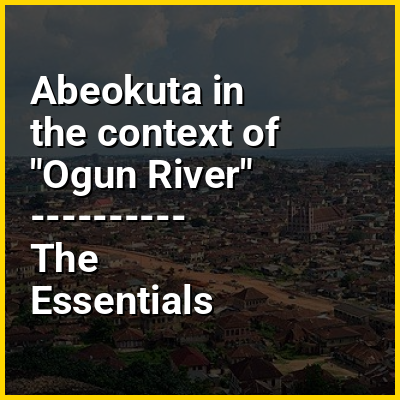
Abeokuta is the capital city of Ogun State, which is located in southwestern Nigeria. It is situated on the east bank of the Ogun River, near a group of rocky outcrops in a wooded savanna; 77 kilometres (48 mi) north of Lagos by railway, or 130 kilometres (81 mi) by water. As of 2006, Abeokuta and the surrounding area had a population of 449,088.
>>>PUT SHARE BUTTONS HERE<<<
In this Dossier
Abeokuta in the context of Egba United Government
The Egba United Government (EUG) was a short-lived but significant government established in the late 19th century by the Egba-Egbado people, a subgroup of the Yoruba ethnic group, in what is now South-western Nigeria and Eastern Benin. Mainly in response to external threats from neighbouring kingdoms, such as the Dahomey and the collapsed Oyo Empire, the Egba towns and villages began to come together to form a loose confederacy, which was later formalized into the Egba United Government in 1893.
In 1898, the government was formally recognized and established by the Lagos Colony Governor, McCallum, at a meeting organized with William Alfred Allen, who was the Colonial Government Agent in Abeokuta and an Egba man from Iporo Ake. This event occurred at the end of the Yoruba civil wars in 1893, making the EUG one of Africa's legally existing governments and nation-states (according to contemporary international laws), ensuring its independence during the Scramble for Africa. William Alfred Allen was appointed the first Secretary to the Government by the Colonial government while the Egba rulers were given government portfolios. Eventually, Allen was succeeded by Adegboyega Edun.
Abeokuta in the context of Ladapo Ademola
Oba Sir Ladapo Samuel Ademola KBE, CMG (1872–1962), also known as Ademola II, was the Alake of Abeokuta from 1920 to 1962. Before he was crowned Alake, Ademola was involved in the affairs of the Egba United Government. As a member of the Egba council, he was a leading participant in negotiations with the Lagos State colonial government in 1889 for the rights to construct railway tracks passing through Egbaland. In 1904 he travelled with Alake Gbadebo to the U.K., where they were received by King Edward VII. He succeeded Oba Gbadebo in 1920 with overwhelming votes from the Egba council.
One of the earliest Nigerian traditional rulers to own a car, he was known to have driven a speed record of over 30 miles from Abeokuta to Ibadan when he traveled to receive the Prince of Wales at Ibadan before the Prince returned to Lagos after a Durbar at Ibadan. Under his headship, the Egba Native Authority continued infrastructural works in Abeokuta started by Gbadebo including road construction and provision of improved electric and water supply in Abeokuta. He was forced to live outside of Abeokuta in 1948 due to tax related demonstrations led by Funmilayo Ransome-Kuti, a member of the regional House of Assembly, but later returned to Abeokuta in 1950.
Abeokuta in the context of Olusegun Obasanjo
Chief Olusegun Matthew Okikiola Ogunboye Aremu Obasanjo GCFR (// ; Yoruba: Olúṣẹ́gun Ọbásanjọ́ [ōlúʃɛ́ɡũ̄ ɔ̄básã̄d͡ʒɔ́] ; born c. 5 March 1937) is a Nigerian politician, statesman, agriculturalist, and former army general who served as Nigeria's military dictator from 1976 to 1979 and later as its president from 1999 to 2007. Ideologically a Nigerian nationalist, he was a member of the Peoples Democratic Party (PDP) from 1998 to 2015, and since 2018.
Born in the village of Ibogun-Olaogun to a farming family of the Owu branch of the Yoruba, Obasanjo was educated largely in Abeokuta, Ogun State. He joined the Nigerian Army and specialised in engineering and served in the Congo, Britain, and India, rising to the rank of Major. In the late 1960s, he played a major role in combating Biafran separatists during the Nigerian Civil War, accepting their surrender in 1970. In 1975, a military coup established a junta with Obasanjo as part of its ruling triumvirate. After the triumvirate's leader, Murtala Muhammed, was assassinated the following year, the Supreme Military Council appointed Obasanjo as Head of State. Continuing Murtala's policies, Obasanjo oversaw budgetary cut-backs and an expansion of access to free school education. Increasingly aligning Nigeria with the United States, he also emphasised support for groups opposing white minority rule in southern Africa. Committed to restoring democracy, Obasanjo oversaw the 1979 election, after which he transferred control of Nigeria to the newly elected civilian president, Shehu Shagari. Obasanjo then retired to Ota, Ogun, where he became a farmer, published four books, and took part in international initiatives to end various African conflicts.
Abeokuta in the context of Ogun State
Ogun State (Yoruba: Ìpínlẹ̀ Ògùn [ìk͡pĩ́lɛ̀ ògũ̀]) is a state in southwestern Nigeria. It is bordered to the south by Lagos State and the Bight of Benin, to the east by Ondo State, and to the north by Oyo and Osun states while its western border forms part of the national border with the Republic of Benin. The capital and largest city is Abeokuta, and the state is divided into 20 local government areas.
Of the 36 states in the country, Ogun is the 24th largest in area but among the top fifteen most populous, with an estimated population of about 6.4 million as of 2020. Geographically, the state lies primarily in the tropical Nigerian lowland forests ecoregion, although parts of the state's north transition into the Guinean forest–savanna mosaic and some of the coastal south reach the Central African mangrove ecoregion. The Ogun and Yewa rivers are the state's major waterways while the Omo Forest Reserve in the southeastern part of the state is one of the most important conservation areas in the country—home to a variety of bird species along with some of Nigeria's last remaining Nigeria-Cameroon chimpanzee and African forest elephant populations.