A Key into the Language of America in the context of "Wampanoag people"

Play Trivia Questions online!

or

Skip to study material about A Key into the Language of America in the context of "Wampanoag people"


⭐ Core Definition: A Key into the Language of America

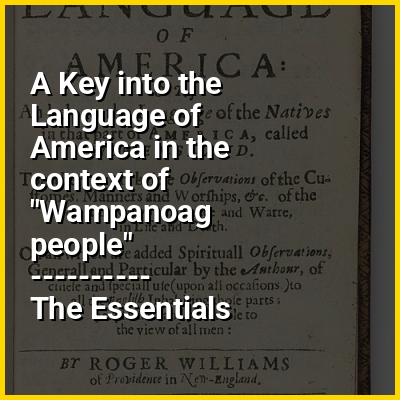
A Key into the Language of America or An help to the Language of the Natives in that part of America called New England is a book written by Roger Williams in 1643 describing the Native American languages in New England in the 17th century, largely Narragansett, an Algonquian language. The book is the first published colonial study of a Native American language in English.

Williams was one of the founders of the Colony of Rhode Island and an exile from the Massachusetts Bay Colony. The book was in part written to halt Massachusetts Bay's claims to Rhode Island's territory. Williams also argued against confiscating Indian land, arguing that the Indians had a right to payment. He had personally interacted with the Narragansett and the Wampanoag tribes as a missionary, friend, and trader, and he wrote favorably about elements of their culture. The book helped to introduce a number of American Indian loan words into the English lexicon.
↓ Menu

In this Dossier

A Key into the Language of America in the context of Roger Williams

Roger Williams (c. 1603 – March 1683) was an English-born New England minister, theologian, author, and founder of the Providence Plantations, which became the Colony of Rhode Island and Providence Plantations and later the State of Rhode Island. He was a staunch advocate for religious liberty, separation of church and state, and fair dealings with the Native Americans.

Initially a Puritan minister, his beliefs evolved and he questioned the authority of the Puritan church in enforcing religious conformity. He was expelled by the Puritan leaders from the Massachusetts Bay Colony, and he established Providence Plantations in 1636 as a refuge offering what he termed "liberty of conscience" making Rhode Island the first government in the Western world to guarantee religious freedom in its founding charter. His ideas on religious tolerance and civil government directly influenced the principles later enshrined in the First Amendment of the U.S. Constitution. He briefly became a Baptist, and in 1638 he founded the First Baptist Church in America in Providence. He then moved beyond organized religion, becoming a "seeker" who did not identify with any specific church. Williams studied the language of the New England Native Americans and published the first book-length study of it in English.

↑ Return to Menu