9th arrondissement of Paris in the context of "Opéra Garnier"

Play Trivia Questions online!

or

Skip to study material about 9th arrondissement of Paris in the context of "Opéra Garnier"


⭐ Core Definition: 9th arrondissement of Paris

The 9th arrondissement of Paris (French: 9e arrondissement de Paris) is one of the twenty arrondissements of the capital city of France. In spoken French, it is referred to as le neuvième ([nœvjɛm]; 'ninth').

The arrondissement, called Opéra, is located on the right bank of the River Seine. It contains many places of cultural, historical and architectural interest, including the Palais Garnier (home to the Paris Opera), on the Place de l'Opéra, together with the InterContinental Paris Le Grand Hotel's Café de la Paix, as well as Boulevard Haussmann, with the Galeries Lafayette and Printemps, two large department stores, in addition to the Le Figaro newspaper. It hosts two historic churches, noted for their classical architecture, art and decoration: Saint-Louis-d'Antin (18th c.) and Notre-Dame-de-Lorette (19th c.).
↓ Menu

In this Dossier

9th arrondissement of Paris in the context of Palais Garnier

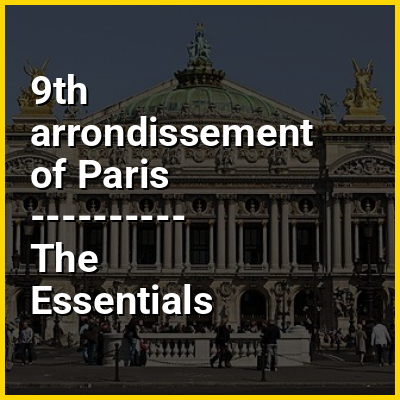
The Palais Garnier (French: [palɛ ɡaʁnje] , Garnier Palace), also known as Opéra Garnier (French: [ɔpeʁa ɡaʁnje] , Garnier Opera), is a historic 1,979-seat opera house at the Place de l'Opéra in the 9th arrondissement of Paris, France. It was built for the Paris Opera from 1861 to 1875 at the behest of Emperor Napoleon III. Initially referred to as le nouvel Opéra de Paris (the new Paris Opera), it soon became known as the Palais Garnier, "in acknowledgment of its extraordinary opulence" and the architect Charles Garnier's plans and designs, which are representative of the Napoleon III style. It was the primary theatre of the Paris Opera and its associated Paris Opera Ballet until 1989, when a new opera house, the Opéra Bastille, opened at the Place de la Bastille. The company now uses the Palais Garnier mainly for ballet. The theatre has been a monument historique of France since 1923.

The Palais Garnier has been called "probably the most famous opera house in the world, a symbol of Paris like Notre Dame Cathedral, the Louvre, or the Sacré Coeur Basilica". This is at least partly due to its use as the setting for Gaston Leroux's 1910 novel The Phantom of the Opera and, especially, the novel's subsequent adaptations in films and the popular 1986 musical. Another contributing factor is that among the buildings constructed in Paris during the Second Empire, besides being the most expensive, it has been described as the only one that is "unquestionably a masterpiece of the first rank".

↑ Return to Menu

9th arrondissement of Paris in the context of Lycée Condorcet

The Lycée Condorcet (French: [lise kɔ̃dɔʁsɛ]) is a secondary school in Paris, France, located at 8, rue du Havre, in the city's 9th arrondissement. Founded in 1803, it is one of the four oldest high schools in Paris and also one of the most prestigious. Since its inception, various political eras have seen it given a number of different names, but its identity today honors the memory of the Marquis de Condorcet. Henri Bergson, Horace Finaly, Claude Lévi-Strauss, Marcel Proust, Jean-Luc Marion, Francis Poulenc and Paul Verlaine are some of the students who attended the Lycée Condorcet.

Some of the school's famous teachers include Jean Beaufret, Paul Bénichou, Jean-Marie Guyau, Jean-Paul Sartre, and Stéphane Mallarmé.

↑ Return to Menu

9th arrondissement of Paris in the context of Le Figaro

Le Figaro (French: [lə fiɡaʁo] ) is a French daily morning newspaper founded in 1826. It was named after Figaro, a character in several plays by polymath Beaumarchais (1732–1799): Le Barbier de Séville, La Mère coupable, and the eponymous Le Mariage de Figaro. One of his lines became the paper's motto: "Without the freedom to criticise, there is no flattering praise".

The oldest national newspaper in France, Le Figaro is considered a French newspaper of record, along with Le Monde and Libération. Since 2004, the newspaper has been owned by Dassault Group. Its editorial director has been Alexis Brézet since 2012. Le Figaro is the second-largest national newspaper in France, after Le Monde. It has a centre-right editorial stance and is headquartered on Boulevard Haussmann in the 9th arrondissement of Paris. Other Groupe Figaro publications include Le Figaro Magazine, TV Magazine and Evene. The paper is published in Berliner format.

↑ Return to Menu

9th arrondissement of Paris in the context of Place de l'Opéra

The Place de l'Opéra (French pronunciation: [plas lɔpeʁa]) is a square in the 9th arrondissement of Paris. It is located at the junction of the Boulevard des Italiens, the Boulevard des Capucines, the Avenue de l'Opéra, the Rue Auber [fr], the Rue Halévy [fr], the Rue de la Paix and the Rue du Quatre-Septembre [fr].

The Place de l'Opéra was built at the same time as the Palais Garnier, the opera house designed by Charles Garnier after which it is named and of which it provides a panoramic view. Both structures were part of Haussmann's renovation of Paris under Napoleon III.

↑ Return to Menu

9th arrondissement of Paris in the context of 2nd arrondissement of Paris

The 2nd arrondissement of Paris (II arrondissement) is one of the 20 arrondissements of the capital city of France. In spoken French, this arrondissement is colloquially referred to as deuxième (second/the second). It is governed locally together with the 1st, 3rd and 4th arrondissement, with which it forms the 1st sector of Paris.

Also known as Bourse, this arrondissement is located on the right bank of the River Seine. The 2nd arrondissement, together with the adjacent 8th and 9th arrondissements, hosts an important business district, centred on the Paris Opéra, which houses the city's most dense concentration of business activities. The arrondissement contains the former Paris Bourse (stock exchange) and several banking headquarters, as well as a textile district, known as the Sentier, and the Opéra-Comique's theatre, the Salle Favart. The 2nd arrondissement is the home of Grand Rex, the largest movie theater in Paris.

↑ Return to Menu

9th arrondissement of Paris in the context of 8th arrondissement of Paris

The 8th arrondissement of Paris (VIII arrondissement) is one of the 20 arrondissements of the capital city of France. In spoken French, the arrondissement is colloquially referred to as le huitième (lit.'the eighth').

The arrondissement, called Élysée, is situated on the right bank of the River Seine and centered on the Avenue des Champs-Élysées. The 8th arrondissement is, together with the 1st, 9th, 16th and 17th arrondissements, one of Paris' main business districts. According to the 1999 census, it was the place of employment of more people than any other single arrondissement of the capital. It is also the location of many places of interest, among them the Champs-Élysées, the Arc de Triomphe (partial) and the Place de la Concorde, as well as the Élysée Palace, the official residence and office of the President of France.

↑ Return to Menu

9th arrondissement of Paris in the context of Boulevard Haussmann

The Boulevard Haussmann (French pronunciation: [bulvaʁ osman]), 2.53-kilometre (1.57 mi) long from the 8th to the 9th arrondissement, is one of the wide tree-lined boulevards created in Paris by Napoleon III, under the direction of his Prefect of the Seine, Baron Haussmann.

The Boulevard Haussmann is mostly lined with apartment blocks, whose regulated cornice height gives a pleasing eyeline to the Boulevard. The department stores Galeries Lafayette and Au Printemps are sited on this street.

↑ Return to Menu

9th arrondissement of Paris in the context of Café de la Paix

The Café de la Paix (French pronunciation: [kafe d(ə) la pɛ]) is a famous café located on the northwest corner of the intersection of the Boulevard des Capucines and the Place de l'Opéra, in the 9th arrondissement of Paris, France. Designed in the Napoleon III style by the architect Alfred Armand, who also designed the historic Grand Hôtel in which the café is located, its florid interior decorations, historic location, and high-profile clientele have all brought it international recognition as a site of great cultural significance.

↑ Return to Menu

9th arrondissement of Paris in the context of Galeries Lafayette

Galeries Lafayette (French pronunciation: [ɡalʁi lafajɛt]) is an upmarket French department store chain. The flagship store is located on Boulevard Haussmann in the 9th arrondissement of Paris. It is part of Groupe Galeries Lafayette and has been a member of the International Association of Department Stores since 1960.

As of 2025, Galeries Lafayette operates 50 stores in France (including five in Greater Paris, and 12 outlet stores), alongside ten international locations (predominantly in Asia). Galeries Lafayette is the largest European upmarket department store chain by store count.

↑ Return to Menu