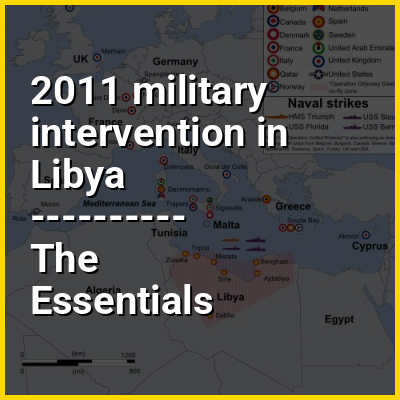
On 19 March 2011, a NATO-led coalition began a military intervention into the ongoing Libyan Civil War to implement United Nations Security Council Resolution 1973 (UNSCR 1973). The UN Security Council passed the resolution with ten votes in favour and five abstentions, with the stated intent to have "an immediate ceasefire in Libya, including an end to the current attacks against civilians, which it said might constitute 'crimes against humanity' ... [imposing] a ban on all flights in the country's airspace — a no-fly zone — and tightened sanctions on Muammar Gaddafi's government and its supporters."
The initial coalition members of Belgium, Canada, Denmark, France, Italy, Norway, Qatar, Spain, UK and US expanded to nineteen states, with later members mostly enforcing the no-fly zone and naval blockade or providing military logistical assistance. The effort was initially led by France and the United Kingdom, with command shared with the United States. Italy only joined the coalition on the condition that NATO took on overall leadership of the mission instead of individual countries. NATO took control of the arms embargo on 23 March, named Operation Unified Protector. An attempt to unify the military command of the air campaign first failed over objections by the French, German, and Turkish governments. On 24 March, NATO agreed to take control of the no-fly zone, while command of targeting ground units remained with individual coalition forces. The handover occurred on 31 March 2011.