2004 Ukrainian presidential election in the context of "Two-round system"

Play Trivia Questions online!

or

Skip to study material about 2004 Ukrainian presidential election in the context of "Two-round system"

Ad spacer

⭐ Core Definition: 2004 Ukrainian presidential election

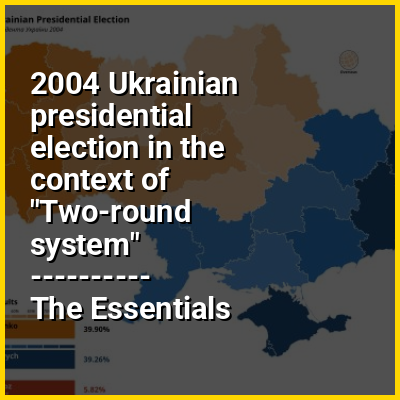
Presidential elections were held in Ukraine on 31 October, 21 November, 26 December 2004 and 1 January 2005. This was the fourth presidential election in Ukraine following independence from the Soviet Union. The last stages of the election were contested between the opposition leader Viktor Yushchenko and incumbent Prime Minister Viktor Yanukovych from the Party of Regions. It was later determined by the Ukrainian Supreme Court that the election was plagued by widespread falsification of the results in favour of Yanukovych.

According to Ukraine's electoral law, a two-round system is used to elect the president in which a candidate must win a majority (50% or more) of all ballots cast. The first round of voting was held on 31 October. As no candidate received over 50% of all votes cast, a run-off between the two highest-polling candidates, Yushchenko and Yanukovych, was held on 21 November. According to official Central Election Commission results announced on 23 November, the run-off election was won by Yanukovych. However, the results were challenged by Yushchenko and his supporters, with many western observers claiming that the election was rigged.
↓ Menu

>>>PUT SHARE BUTTONS HERE<<<
In this Dossier

2004 Ukrainian presidential election in the context of Viktor Yanukovych

Viktor Fedorovych Yanukovych (born 9 July 1950) is a former Ukrainian politician who served as the fourth president of Ukraine from 2010 to 2014. He also served as the prime minister of Ukraine several times between 2002 and 2007 and was a member of the Verkhovna Rada (parliament) from 2006 to 2010. Yanukovych was removed from the presidency during the 2014 Revolution of Dignity, which followed months of protests against him. Since then, he has lived in exile in Russia.

Yanukovych was a member of the pro-Russian Party of Regions. Before entering national politics, Yanukovych was the governor of his native Donetsk Oblast from 1997 to 2002. He was simultaneously the chairman of the oblast's legislature from 1999 to 2001. He first ran for president in the 2004 election, where he was declared the winner against Viktor Yushchenko. However, allegations of electoral fraud and voter intimidation caused widespread protests, in what became known as the Orange Revolution. The Ukrainian Supreme Court nullified the election and ordered a rerun, which Yanukovych lost to Yushchenko. Yanukovych ran for president again in 2010, this time beating Yulia Tymoshenko in an election deemed free and fair by international observers.

↑ Return to Menu

2004 Ukrainian presidential election in the context of Ukrainian presidential elections

Ukrainian presidential elections determine who will serve as the President of Ukraine for the next five years.

Since the establishment of the position of the President of Ukraine in 1991, presidential elections have taken place seven times: in 1991, 1994, 1999, 2004, 2010, 2014 and 2019. The next election would have been scheduled for 2024; however, it was not held because of the full-scale Russian invasion of Ukraine ongoing since 24 February 2022 and the resulting imposition of martial law in Ukraine, under which elections legally cannot be held.

↑ Return to Menu

2004 Ukrainian presidential election in the context of Orange Revolution

The Orange Revolution (Ukrainian: Помаранчева революція, romanizedPomarancheva revoliutsiia) was a series of protests that led to political upheaval in Ukraine from late November 2004 to January 2005. It gained momentum primarily due to the initiative of the general population, sparked by the aftermath of the 2004 Ukrainian presidential election run-off which was claimed to be marred by massive corruption, voter intimidation and electoral fraud. Kyiv, the Ukrainian capital, was the focal point of the movement's campaign of civil resistance, with thousands of protesters demonstrating daily. Nationwide, this was highlighted by a series of acts of civil disobedience, sit-ins, and general strikes organized by the opposition movement.

The protests were prompted by reports from several domestic and foreign election monitors as well as the widespread public perception that the results of the run-off vote of 21 November 2004 between leading candidates Viktor Yushchenko and Viktor Yanukovych were rigged by the authorities in favour of the latter. The nationwide protests succeeded when the results of the original run-off were annulled, and a revote was ordered by Ukraine's Supreme Court for 26 December 2004. Under intense scrutiny by domestic and international observers, the second run-off was declared to be "free and fair". The final results showed a clear victory for Yushchenko, who received about 52% of the vote, compared to Yanukovych's 44%. Yushchenko was declared the official winner and with his inauguration on 23 January 2005 in Kyiv, the Orange Revolution ended. In the following years, the Orange Revolution had a negative connotation among pro-government circles in Belarus and Russia.

↑ Return to Menu