1991 eruption of Mount Pinatubo in the context of "Lava dome"

Play Trivia Questions online!

or

Skip to study material about 1991 eruption of Mount Pinatubo in the context of "Lava dome"

Ad spacer

⭐ Core Definition: 1991 eruption of Mount Pinatubo

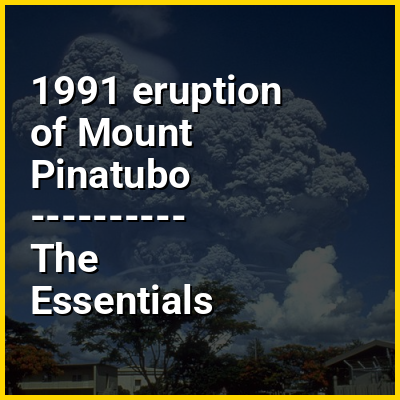
The 1991 eruption of Mount Pinatubo in the Philippines' Luzon Volcanic Arc was the second-largest volcanic eruption of the 20th century, behind only the 1912 eruption of Novarupta in Alaska. Eruptive activity began on April 2 as a series of phreatic explosions from a fissure that opened on the north side of Mount Pinatubo. Seismographs were set up and began monitoring the volcano for earthquakes. In late May, the number of seismic events under the volcano fluctuated from day-to-day. Beginning June 6, a swarm of progressively shallower earthquakes accompanied by inflationary tilt on the upper east flank of the mountain, culminated in the extrusion of a small lava dome.

On June 12, the volcano's first spectacular eruption sent an ash column 19 km (12 mi) into the atmosphere. Additional explosions occurred overnight and the morning of June 13. Seismic activity during this period became intense. When even more highly gas-charged magma reached Pinatubo's surface on June 15, the volcano exploded, sending an ash cloud 40 km (25 mi) into the atmosphere. Volcanic ash and pumice blanketed the countryside. Huge pyroclastic flows roared down the flanks of Pinatubo, filling once-deep valleys with fresh volcanic deposits as much as 200 m (660 ft) thick. The eruption removed so much magma and rock from beneath the volcano that the summit collapsed to form a small caldera 2.5 km (1.6 mi) across.
↓ Menu

>>>PUT SHARE BUTTONS HERE<<<
In this Dossier

1991 eruption of Mount Pinatubo in the context of Mount Pinatubo

Mount Pinatubo is an active stratovolcano in the Zambales Mountains in Luzon in the Philippines. Located on the tripoint of Zambales, Tarlac and Pampanga provinces, most people were unaware of its eruptive history before the pre-eruption volcanic activity in early 1991. Dense forests, which supported a population of several thousand indigenous Aetas, heavily eroded and obscured Pinatubo.

Pinatubo is known for its VEI-6 eruption on June 15, 1991, the second-largest terrestrial eruption of the 20th century after the 1912 eruption of Novarupta in Alaska. The eruption coincided with Typhoon Yunya making landfall in the Philippines, which brought a dangerous mix of ash and rain to nearby towns and cities. Early predictions led to the evacuation of tens of thousands of people, saving many lives. The eruption severely damaged surrounding areas with pyroclastic surges, pyroclastic falls, and later, flooding lahars caused by rainwater re-mobilizing volcanic deposits. This destruction affected infrastructure and altered river systems for years. Minor dome-forming eruptions inside the caldera continued from 1992 to 1993.

↑ Return to Menu

1991 eruption of Mount Pinatubo in the context of Hunga Tonga–Hunga Haʻapai

Hunga Tonga–Hunga Haʻapai (listen) is a submarine volcano in the South Pacific located about 30 km (19 mi) south of the submarine volcano of Fonuafoʻou and 65 km (40 mi) north of Tongatapu, Tonga's main island. It is part of the highly active Kermadec-Tonga subduction zone and its associated volcanic arc, which extends from New Zealand north-northeast to Fiji, and is formed by the subduction of the Pacific Plate under the Indo-Australian Plate. It lies about 100 km (62 mi) above an active seismic zone. The volcano rises around 2,000 m from the seafloor and has a caldera which on the eve of the 2022 eruption was roughly 150 m below sea level and 4 km at its widest extent. The only major above-water part of the volcano are the twin uninhabited islands of Hunga Tonga and Hunga Haʻapai, which are respectively part of the northern and western rim of the caldera. As a result of the volcano's eruptive history, the islands existed as a single landmass from 2015 to 2022: they were merged by a volcanic cone in a volcanic eruption in 2014–2015, and were separated again by a more explosive eruption in 2022, which also reduced the islands in size. The Hunga Tonga–Hunga Haʻapai volcano has seven historical recorded eruptions.

The most recent eruption, in January 2022, triggered a tsunami that reached the coasts of Japan and the Americas, along with a volcanic plume that soared 58 km (36 miles) into the mesosphere. It was the largest volcanic eruption since the 1991 eruption of Mount Pinatubo and the biggest explosion recorded in the atmosphere by modern instrumentation, far surpassing any 20th-century volcanic event or nuclear bomb test. NASA determined that the eruption was "hundreds of times more powerful" than the atomic bomb dropped on Hiroshima. It is believed that the 1883 eruption of Krakatoa is the only eruption in recent centuries that rivaled the atmospheric disturbance it produced. The January 2022 eruption is the largest volcanic eruption in the 21st century.

↑ Return to Menu

1991 eruption of Mount Pinatubo in the context of Typhoon Yunya (1991)

Typhoon Yunya, known in the Philippines as Typhoon Diding, was a strong tropical cyclone whose landfall in the Philippines coincided with the 1991 eruption of Mount Pinatubo. A small tropical cyclone, Yunya rapidly developed from a tropical disturbance near East Samar on June 11. By June 13 the storm had reached typhoon status as it moved west-northwest near the Philippines. Yunya attained its peak intensity the following day with estimated winds of 145 km/h (90 mph); however, strong wind shear soon impacted the typhoon and caused it to rapidly decay. The storm struck southern Luzon early on June 15 as a minimal typhoon before moving over the South China Sea later that day. After turning north and weakening to a tropical depression, the system brushed the southern tip of Taiwan on June 16 before dissipating the following day.

↑ Return to Menu

1991 eruption of Mount Pinatubo in the context of History of the Philippines (1986–present)

This article covers the history of the current Philippine republican state following the 1986 People Power Revolution, known as the Fifth Philippine Republic.

The return of democracy and government reforms beginning in 1986 were hampered by national debt, government corruption, coup attempts, disasters, a persistent communist insurgency, and a military conflict with Moro separatists. During Corazon Aquino's administration, U.S. forces withdrew from the Philippines, due to the rejection of the U.S. Bases Extension Treaty, and leading to the official transfer to the government of Clark Air Base in November 1991 and Subic Bay in December 1992. The administration also faced a series of natural disasters, including the eruption of Mount Pinatubo in June 1991.

↑ Return to Menu

1991 eruption of Mount Pinatubo in the context of 2022 Hunga Tonga–Hunga Haʻapai eruption and tsunami

In December 2021, an eruption began on Hunga Tonga–Hunga Haʻapai, a submarine volcano in the Tongan archipelago in the southern Pacific Ocean. The eruption reached a very large and powerful climax nearly four weeks later, on 15 January 2022. Hunga Tonga–Hunga Haʻapai is 65 kilometres (40 mi) north of Tongatapu, the country's main island, and is part of the highly active Tonga–Kermadec Islands volcanic arc, a subduction zone extending from New Zealand to Fiji. On the Volcanic Explosivity Index scale, the eruption was rated at least a VEI-5. Described by scientists as a "magma hammer", the volcano at its height produced a series of four underwater thrusts, displaced 10 cubic kilometres (2.4 cu mi) of rock, ash and sediment, and generated the largest atmospheric explosion recorded by modern instrumentation.

The eruption produced a volcanic tsunami that affected Tonga, Fiji, American Samoa, Samoa, Vanuatu, New Zealand, Japan, the United States, the Russian Far East, Chile and Peru. At least four people were killed, some were injured, and some remain possibly missing in Tonga from tsunami waves up to 20 m (66 ft) high. Tsunami waves with run-up heights up to 45 m (148 ft) struck the uninhabited island of Tofua. Two people drowned in Peru when 2 m (6 ft 7 in) waves struck the coast, while another died of indirect causes in Fiji. It was the largest volcanic eruption since the 1991 eruption of Mount Pinatubo. NASA determined that the eruption was "hundreds of times more powerful" than Little Boy. The eruption was the largest explosion recorded in the atmosphere by modern instrumentation, far larger than any 20th-century volcanic event or nuclear bomb test. It is thought that in recent centuries, only the Krakatoa eruption of 1883 rivalled the atmospheric disturbance produced.

↑ Return to Menu

1991 eruption of Mount Pinatubo in the context of USS Peleliu

21°22′24″N 157°58′51″W / 21.3732154°N 157.9809546°W / 21.3732154; -157.9809546

USS Peleliu (LHA-5) is a Tarawa-class amphibious assault ship of the United States Navy, named for the Battle of Peleliu of World War II. Entering service in 1980, she has been deployed to the Persian Gulf on several occasions, performed an evacuation of U.S. Naval Base Subic Bay following the eruption of Mount Pinatubo, operated with the INTERFET peacekeeping taskforce, participated in Pacific Partnership deployments, and provided assistance following the massive floods in Pakistan in 2010. She was decommissioned in San Diego, California on 31 March 2015. She currently rests, out of commission and in reserve, at NAVSEA Inactive Ships On-site Maintenance Office, Pearl Harbor, Hawaii in the inactive reserve in case of further need.

↑ Return to Menu