1980 United States presidential election in the context of "Ted Kennedy 1980 presidential campaign"

Play Trivia Questions online!

or

Skip to study material about 1980 United States presidential election in the context of "Ted Kennedy 1980 presidential campaign"


⭐ Core Definition: 1980 United States presidential election

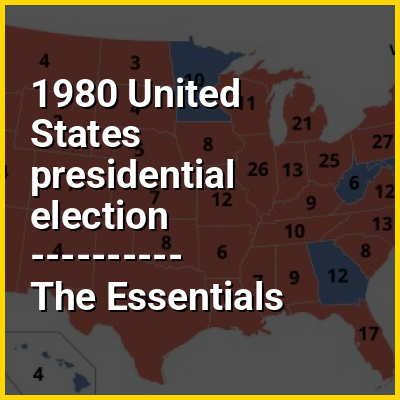
Presidential elections were held in the United States on November 4, 1980. In a landslide victory, the Republican ticket of former California governor Ronald Reagan and former director of central intelligence George H. W. Bush defeated the Democratic ticket of incumbent president Jimmy Carter and vice president Walter Mondale and the Independent ticket of Congressman John B. Anderson and former ambassador to Mexico Patrick Lucey. Because of the rise of conservatism after Reagan's victory, many historians consider the election a political realignment.

Carter's unpopularity, his poor relations with Democratic leaders, and the poor economic conditions under his administration encouraged an unsuccessful intra-party challenge from Massachusetts Senator Ted Kennedy. Meanwhile, the Republican primaries were contested between Reagan, former Central Intelligence Agency director George H. W. Bush, Illinois representative John B. Anderson, and several other candidates. All of Reagan's opponents had dropped out by the end of the primaries, and the Republicans nominated a ticket consisting of Reagan and Bush. Anderson entered the general election as an independent candidate with former Wisconsin governor Patrick Lucey as his running mate.
↓ Menu

In this Dossier

1980 United States presidential election in the context of Presidency of Jimmy Carter

Jimmy Carter's tenure as the 39th president of the United States began with his inauguration on January 20, 1977, and ended on January 20, 1981. Carter, a Democrat from Georgia, took office following his narrow victory over Republican incumbent president Gerald Ford in the 1976 presidential election. His presidency ended following his landslide defeat in the 1980 presidential election to Republican Ronald Reagan, after one term in office. At the time of his death at the age of 100, he was the oldest living, longest-lived and longest-married president, and has the longest post-presidency.

Carter took office during a period of "stagflation", as the economy experienced a combination of high inflation and slow economic growth. His budgetary policies centered on taming inflation by reducing deficits and government spending. Responding to energy concerns that had persisted through much of the 1970s, his administration enacted a national energy policy designed for long-term energy conservation and the development of alternative resources. In the short term, the country was beset by an energy crisis in 1979 which was overlapped by a recession in 1980. Carter sought reforms to the country's welfare, health care, and tax systems, but was largely unsuccessful, partly due to poor relations with Democrats in Congress.

↑ Return to Menu

1980 United States presidential election in the context of Ronald Reagan

Ronald Wilson Reagan (February 6, 1911 – June 5, 2004) was an American politician and actor who served as the 40th president of the United States from 1981 to 1989. A member of the Republican Party, he became an important figure in the American conservative movement. The period encompassing his presidency is known as the Reagan era.

Born in Tampico, Illinois, Reagan graduated from Eureka College in 1932 and was hired the next year as a sports broadcaster in Iowa. In 1937, he moved to California where he became a well-known film actor. During his acting career, Reagan was president of the Screen Actors Guild twice from 1947 to 1952 and from 1959 to 1960. In the 1950s, he hosted General Electric Theater and worked as a motivational speaker for General Electric. During the 1964 presidential election, Reagan's "A Time for Choosing" speech launched his rise as a leading conservative figure. After being elected governor of California in 1966, he raised state taxes, turned the state budget deficit into a surplus and implemented crackdowns on university protests. Following his loss to Gerald Ford in the 1976 Republican Party presidential primaries, Reagan won the Republican Party's nomination and then obtained a landslide victory over President Jimmy Carter in the 1980 presidential election.

↑ Return to Menu

1980 United States presidential election in the context of Ronald Reagan presidential campaign, 1980

The 1980 presidential campaign of Ronald Reagan was a successful election campaign for President of the United States in 1980 by former California governor Ronald Reagan, and former CIA director George H. W. Bush. Reagan and Bush, defeated incumbent President Jimmy Carter and incumbent Vice President Walter Mondale. Reagan, a Republican who had also tried to seek the Republican nomination in 1976, launched his 1980 presidential bid on November 13, 1979, and secured nomination for his election on July 17, 1980. On November 4th, 1980, Reagan and Bush defeated Carter and Mondale in an electoral college landslide, winning 489 electoral votes compared to Carter and Mondale’s 49 electoral votes.

Reagan, a Republican and former governor of California, announced his third presidential bid in a nationally televised speech from New York City in 1979. He campaigned extensively for the primaries after losing the Iowa caucus to former congressman and director of the Central Intelligence Agency Bush. In the primaries, he won 44 states and 59.8 percent of the vote. He decided initially to nominate former president Gerald Ford as his running mate, but Ford wanted such extended powers as vice president, especially over foreign policy, that their ticket would effectively amount to a "co-presidency". As a result, negotiations to form a Reagan–Ford ticket ceased. Reagan then selected Bush as his vice-presidential running mate.

↑ Return to Menu

1980 United States presidential election in the context of Presidency of Ronald Reagan

Ronald Reagan's tenure as the 40th president of the United States began with his first inauguration on January 20, 1981, and ended on January 20, 1989. Reagan, a Republican from California, took office after defeating the Democratic incumbent president Jimmy Carter and independent congressman John B. Anderson in the 1980 presidential election. Four years later, he won re-election in the 1984 presidential election, after defeating the Democratic nominee Walter Mondale. Bush was constitutionally limited to two terms and was succeeded by his vice president, George H. W. Bush, who won the 1988 presidential election. Reagan's 1980 landslide election resulted from a conservative shift to the right in American politics, including a loss of confidence in liberal, New Deal, and Great Society programs and priorities that had dominated the national agenda since the 1930s.

Domestically, the Reagan administration enacted a major tax cut, sought to cut non-military spending, and eliminated federal regulations. The administration's economic policies, known as "Reaganomics", were inspired by supply-side economics. The combination of tax cuts and an increase in defense spending led to budget deficits, and the federal debt increased significantly during Reagan's tenure. Reagan signed the Tax Reform Act of 1986, simplifying the tax code by reducing rates and removing several tax breaks, and the Immigration Reform and Control Act of 1986, which enacted sweeping changes to U.S. immigration law and granted amnesty to three million illegal immigrants. Reagan also appointed more federal judges than any other president, including four Supreme Court Justices.

↑ Return to Menu

1980 United States presidential election in the context of Mandate for Leadership

Mandate for Leadership is a series of books published by the Heritage Foundation, an American conservative think tank based in Washington, D.C. They offer specific conservative policy recommendations designed to be implemented by the federal government. The books have traditionally been released to coincide with an incoming U.S. presidential administration. The first edition was released in 1981, following the election of Ronald Reagan, to serve as policy guidance for the incoming Reagan administration. The latest edition, published in April 2023, is a major component of Project 2025.

↑ Return to Menu

1980 United States presidential election in the context of 1964 United States Senate election in Texas

The 1964 United States Senate election in Texas was held on November 3, 1964. Incumbent Democratic US senator Ralph Yarborough defeated future US President George H. W. Bush handily. This would prove to be Yarborough's final term as a senator. Bush later went on to win an election for the US House of Representatives in 1966 and was subsequently elected US Vice President in 1980, re-elected in 1984, and was elected president in 1988.

↑ Return to Menu

1980 United States presidential election in the context of 1980 Republican Party presidential primaries

From January 21 to June 28, 1980, voters of the Republican Party chose its nominee for president in the 1980 United States presidential election. Retired Hollywood actor and two-term California governor Ronald Reagan was selected as the nominee through a series of primary elections and caucuses culminating in the Republican National Convention held from July 14 to 17, 1980, in Detroit, Michigan. This was the last Republican primary which featured the nominee choosing a fellow candidate as his running mate.

↑ Return to Menu

1980 United States presidential election in the context of John B. Anderson

John Bayard Anderson (February 15, 1922 – December 3, 2017) was an American lawyer and politician who served in the United States House of Representatives, representing Illinois's 16th congressional district from 1961 to 1981. Initially a member of the Republican Party, he also served as the Chairman of the House Republican Conference from 1969 until 1979. In 1980, he ran an independent campaign for president, receiving 6.6% of the popular vote.

Born in Rockford, Illinois, Anderson practiced law after serving in the Army during World War II. After a stint in the United States Foreign Service, he won election as the State's Attorney for Winnebago County, Illinois. He won election to the House of Representatives in 1960 in a strongly Republican district. Initially one of the most conservative members of the House, Anderson's views moderated during the 1960s, particularly regarding social issues. He became chairman of the House Republican Conference in 1969 and remained in that position until 1979. He strongly criticized the Vietnam War as well as President Richard Nixon's actions during the Watergate scandal.

↑ Return to Menu

1980 United States presidential election in the context of Reagan administration

Ronald Reagan's tenure as the 40th president of the United States began with his first inauguration on January 20, 1981, and ended on January 20, 1989. Reagan, a Republican from California, took office after defeating the Democratic incumbent president Jimmy Carter and independent congressman John B. Anderson in the 1980 presidential election. Four years later, he won re-election in the 1984 presidential election, after defeating the Democratic nominee Walter Mondale. Reagan was constitutionally limited to two terms and was succeeded by his vice president, George H. W. Bush, who won the 1988 presidential election. Reagan's 1980 landslide election resulted from a conservative shift to the right in American politics, including a loss of confidence in liberal, New Deal, and Great Society programs and priorities that had dominated the national agenda since the 1930s.

Domestically, the Reagan administration enacted a major tax cut, sought to cut non-military spending, and eliminated federal regulations. The administration's economic policies, known as "Reaganomics", were inspired by supply-side economics. The combination of tax cuts and an increase in defense spending led to budget deficits, and the federal debt increased significantly during Reagan's tenure. Reagan signed the Tax Reform Act of 1986, simplifying the tax code by reducing rates and removing several tax breaks, and the Immigration Reform and Control Act of 1986, which enacted sweeping changes to U.S. immigration law and granted amnesty to three million illegal immigrants. Reagan also appointed more federal judges than any other president, including four Supreme Court Justices.

↑ Return to Menu