1976 Argentine coup d'état in the context of "Armed Forces of the Argentine Republic"

Play Trivia Questions online!

or

Skip to study material about 1976 Argentine coup d'état in the context of "Armed Forces of the Argentine Republic"


⭐ Core Definition: 1976 Argentine coup d'état

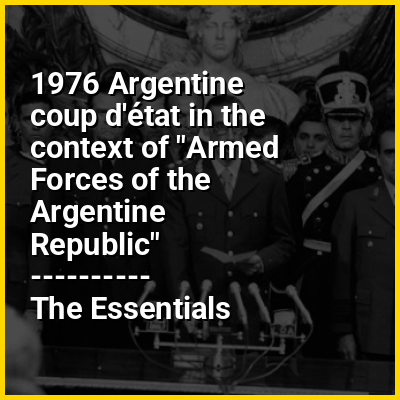
The 1976 Argentine coup d'état was a coup d'état that overthrew Isabel Perón as President of Argentina on 24 March 1976. A military junta was installed to replace her; this was headed by Lieutenant General Jorge Rafael Videla, Admiral Emilio Eduardo Massera, and Brigadier-General Orlando Ramón Agosti. The political process initiated on 24 March 1976 took the official name of "National Reorganization Process", and different juntas remained in power until the return to democracy on 10 December 1983.

The military coup had been planned since October 1975; the Perón government learned of the preparations two months before its execution. Henry Kissinger met several times with Argentine Armed Forces leaders after the coup, urging them to destroy their opponents quickly before outcry over human rights abuses grew in the United States.

↓ Menu

In this Dossier

1976 Argentine coup d'état in the context of National Reorganization Process

The National Reorganization Process (Spanish: Proceso de Reorganización Nacional, PRN; often simply el Proceso, "the Process") was the military dictatorship that ruled Argentina from the coup d'état of March 24, 1976, until the unconditional transfer of power to a government elected by the citizens on December 10, 1983. In Argentina it is often known simply as the última junta militar ("last military junta"), última dictadura militar ("last military dictatorship"), última dictadura cívico-militar ("last civil–military dictatorship"), or última dictadura cívico-eclesial-militar ("last civil–clerical-military dictatorship") — because there have been several in the country's history and no others like it since it ended. It took the form of a bureaucratic-authoritarian state and was characterized by establishing a systematic plan of state terrorism, which included murders, kidnappings, torture, forced disappearances, and the kidnapping of babies (and concealment of their identity). It is considered "the bloodiest dictatorship in Argentine history".

The Argentine Armed Forces seized political power during the March 1976 coup against the presidency of Isabel Perón, the successor and widow of former President Juan Perón, at a time of growing economic and political instability. Congress was suspended, political parties were banned, civil rights were limited, and free market and deregulation policies were introduced. The President of Argentina and his ministers were appointed from military personnel while leftists and Peronists were persecuted. The junta launched the Dirty War, a campaign of state terrorism against opponents involving torture, extrajudicial murder and systematic forced disappearances. Public opposition due to civil rights abuses and inability to solve the worsening economic crisis in Argentina caused the junta to invade the Falkland Islands in April 1982. After starting and then losing the Falklands War against the United Kingdom in June, the junta began to collapse and finally relinquished power in 1983 with the election of President Raúl Alfonsín.

↑ Return to Menu

1976 Argentine coup d'état in the context of Clandestine detention center (Argentina)

The clandestine detention, torture and extermination centers were secret facilities (ie, black sites) used by the Armed, Security and Police Forces of Argentina to torture, interrogate, rape, illegally detain and murder people. The first ones were installed in 1975, during the constitutional government of Isabel Perón. Their number and use became generalized after the coup d'état of March 24, 1976, when the National Reorganization Process took power, to execute the systematic plan of enforced disappearance of people during the Dirty War. With the fall of the dictatorship and the assumption of the democratic government of Raúl Alfonsín on December 10, 1983, the CCDs ceased to function, although there is evidence that some of them continued to operate during the first months of 1984.

The Armed Forces classified the CCDs into two types:

↑ Return to Menu

1976 Argentine coup d'état in the context of Emilio Eduardo Massera

Emilio Eduardo Massera (19 October 1925 – 8 November 2010) was an Argentine Naval military officer and a leading participant in the Argentine coup d'état of 1976. In 1981, he was found to be a member of P2 (also known as Propaganda Due), a clandestine Masonic lodge involved in Italy's strategy of tension. Many considered Massera to have masterminded the junta's Dirty War against political opponents, which resulted in over 30,000 deaths and disappearances.

↑ Return to Menu

1976 Argentine coup d'état in the context of Isabel Perón

Isabel Martínez de Perón (Spanish pronunciation: [isaˈβel maɾˈtines ðe peˈɾon] , born María Estela Martínez Cartas; 4 February 1931) is an Argentine politician who served as the 41st president of Argentina from 1974 to 1976. She was one of the first female republican heads of state in the world, and the first woman to serve as president of a country. Perón was the third wife of President Juan Perón. During her husband's third term as president from 1973 to 1974, she served as both the 29th vice president and first lady of Argentina. From 1974 until her resignation in 1985, she was also the second President of the Justicialist Party. Isabel Perón's politics exemplify right-wing Peronism and Orthodox Peronism. Ideologically, she was considered close to corporate neo-fascism.

Following her husband's death in office in 1974, she served as President for almost two years before the military took over the government with the 1976 coup. Perón was then placed under house arrest for five years before she was exiled to Spain in 1981. After democracy was restored in Argentina in 1983, she was a guest of honor at President Raúl Alfonsín's inauguration. For several years, she was a nominal head of Juan Perón's Justicialist Party and played a constructive role in reconciliation discussion, but has never again played any important political role.

↑ Return to Menu