1969 Sudanese coup d'état in the context of 1971 Sudanese coup d'état


1969 Sudanese coup d'état in the context of 1971 Sudanese coup d'état

⭐ Core Definition: 1969 Sudanese coup d'état

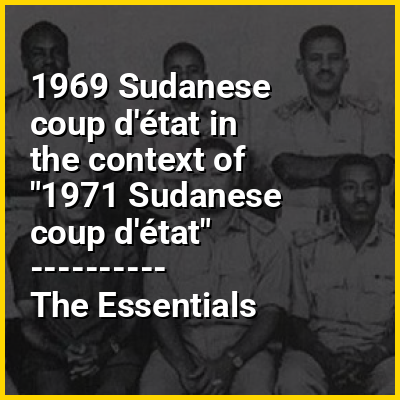
The 1969 Sudanese coup d'état was a successful coup, led by Colonel Gaafar Nimeiry, against the government of President Ismail al-Azhari. The coup signaled the end of Sudan's second democratic era, and saw the beginning of Nimeiry's 16 year rule.

Nimeiry's government would pursue a radical Arab nationalist and leftist program, bringing in a socialist program for social and economic development, including widespread nationalization of private property. His government would also push for an end to the First Sudanese Civil War, which by 1969 had been ongoing for nearly 14 years. In pursuing peace, the new government pushed for amnesty, and would declare regional autonomy for southern Sudan on 9 June 1969.
↓ Menu
HINT:

👉 1969 Sudanese coup d'état in the context of 1971 Sudanese coup d'état

The 1971 Sudanese coup d'état was a short-lived communist-backed coup, led by Major Hashem al Atta, one of the founding members of the free officers organization that carried out a coup two years prior, against the government of President Gaafar Nimeiry. The coup took place on 19 July 1971, toppling the government of the Democratic Republic of the Sudan, but failed to garner support either domestically or internationally. After several days Nimeiry loyalists launched a counter-coup, freeing Nimeiry and toppling Atta's government.

Following the coup Nimeiry, pushed by Defense Minister Khalid Hassan Abbas, made moves to strengthen his rule, and by the end of the year ultimate authority had transferred from the multi-member Revolutionary Command Council to the Presidency, held by Nimeiry. Over the next several years, the remaining former members of the RCC would see their authority diminished, and by 1975 all but Abu al-Gasim Mohammed Ibrahim had been forced out of government.

↓ Explore More Topics
In this Dossier

1969 Sudanese coup d'état in the context of Ismail al-Azhari

Ismail al-Azhari (Arabic: إسماعيل الأزهري, romanizedʼIsmāʻīl al-Azharī; October 20, 1900 – August 26, 1969) was a Sudanese nationalist and political figure. He served as the first Prime Minister of Sudan between 1954 and 1956, and as Head of State of Sudan from 1965 until he was overthrown by Gaafar Nimeiry in 1969.

He was president of the National Unionist Party (now the Democratic Unionist Party) when the unionist parties united under his leadership. In 1954 he was elected prime minister from within the parliament and under the influence of the growing sense of the need for independence of Sudan and before the union discussion with Egypt. With the support of the independent movement, he submitted the proposal to declare independence to parliament. He assumed the post of president of the Council of Sovereignty after the revolution of October 1964 during the second period of democracy. He was arrested during the May 1969 coup and imprisoned in Cooper prison and when his health declined, he was admitted to hospital, where he remained until his death.

View the full Wikipedia page for Ismail al-Azhari
↑ Return to Menu

1969 Sudanese coup d'état in the context of Gaafar Nimeiry

Gaafar Muhammad an-Nimeiry (otherwise spelled in English as Gaafar Nimeiry, Jaafar Nimeiry, or Ja'far Muhammad Numayri; Arabic: جعفر محمد النميري; 1 January 1930 – 30 May 2009) was a Sudanese military officer and politician who served as the fourth head of state of Sudan from 1969 to 1985, first as Chairman of the National Revolutionary Command Council and then as President.

A military officer, he came to power after a military coup in 1969. Establishing a one-party state, with his Sudanese Socialist Union as the sole legal political entity in the country, Nimeiry pursued socialist and Pan-Arabist policies and close collaboration with Gamal Abdel Nasser of Egypt and Muammar Gaddafi of Libya. In 1971 Nimeiry survived a pro-Soviet coup attempt, after which he forged an alliance with Mao Zedong of China, and, eventually, with the United States as well.

View the full Wikipedia page for Gaafar Nimeiry
↑ Return to Menu

1969 Sudanese coup d'état in the context of Democratic Republic of Sudan

On 25 May 1969, several young officers calling themselves the Free Officers Movement (after the Egyptian officers who instigated the Egyptian revolution of 1952) seized power in Sudan in a coup d'état and started the Nimeiry era, also called the May Regime, in the history of Sudan. Gaafar Nimeiry ruled as president with the Sudanese Socialist Union (SSU). At the conspiracy's core were nine officers led by Colonel Gaafar Nimeiry, who had been implicated in plots against the Abboud regime. Nimeiry's coup preempted plots by other groups, most of which involved army factions supported by the Sudanese Communist Party (SCP), Arab nationalists, or conservative religious groups. He justified the coup on the grounds that civilian politicians had paralyzed the decision-making process, had failed to deal with the country's economic and regional problems, and had left Sudan without a permanent constitution.

View the full Wikipedia page for Democratic Republic of Sudan
↑ Return to Menu

1969 Sudanese coup d'état in the context of National Congress (Sudan)

The National Congress Party (NCP; Arabic: حزب المؤتمر الوطني, Ḥizb al-Mu'tamar al-Waṭanī) was a major political party of ousted Sudanese President Omar al-Bashir, it dominated domestic politics in Sudan from its foundation until it was banned following the Sudanese revolution.

After a military coup in 1969, Sudanese President Gaafar Nimeiry abolished all other political parties, effectively dissolving the Islamic parties. Following political transition in 1985, the leader of Islamic Charter Front (ICF), Hassan al-Turabi, reorganised the former party into the National Islamic Front (NIF), which pushed for an Islamist constitution. The NIF ultimately backed another military coup bringing to power Omar al-Bashir, who publicly endorsed the NIF's Islamist agenda. The party structure was composed at the national level of the General Conference, the Shura Council and the Leadership Council, and the Executive Office.

View the full Wikipedia page for National Congress (Sudan)
↑ Return to Menu

1969 Sudanese coup d'état in the context of Taqali

Taqali (also spelled Tegali from the Tagale people) was a state of Nuba peoples that existed in the Nuba Mountains, in modern-day central Sudan. It is believed to have been founded in the eighteenth century, though oral traditions suggest it was established two centuries earlier. Due in part to its geographic position on a plateau surrounded by desert, Taqali was able to maintain its independence for some 130 years despite the presence of hostile neighbors. It was conquered by Sudanese Mahdists in 1884 and restored as a British client state in 1889. Its administrative power ended with the 1969 Sudanese coup, though the Makk of Taqali, its traditional leader, retains ceremonial power in the region.

View the full Wikipedia page for Taqali
↑ Return to Menu

1969 Sudanese coup d'état in the context of National Revolutionary Command Council (Sudan)

The National Revolutionary Command Council (NRCC) was the body that ruled Sudan after the coup d'état in May 1969. It was disbanded in October 1971.

Initially Babiker Awadalla, a lawyer, served as Premier, but was then moved by Maj-Gen Gaafar Nimeiry to become deputy chair of the council on 26 November 1969. Joseph Garang, a southerner, was also on the council in its initial days.

View the full Wikipedia page for National Revolutionary Command Council (Sudan)
↑ Return to Menu