1952 Republican National Convention in the context of Taft–Hartley Act


1952 Republican National Convention in the context of Taft–Hartley Act

⭐ Core Definition: 1952 Republican National Convention

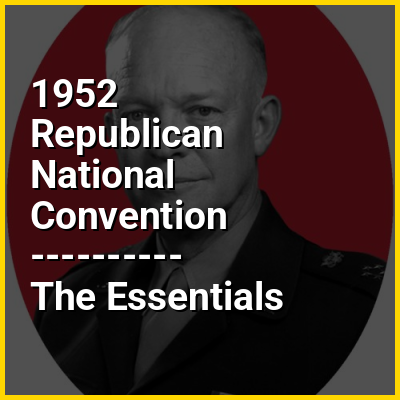
The 1952 Republican National Convention was held at the International Amphitheatre in Chicago, Illinois from July 7 to 11, 1952, and nominated Dwight D. Eisenhower of New York, nicknamed "Ike", for president and Richard M. Nixon of California for vice president.

The Republican platform pledged to end the unpopular war in Korea, supported the development of nuclear weapons as a deterrence strategy, to fire all "the loafers, incompetents and unnecessary employees" at the State Department, condemned the Roosevelt and Truman administrations' economic policies, supported retention of the Taft–Hartley Act, opposed "discrimination against race, religion or national origin", supported "Federal action toward the elimination of lynching", and pledged to bring an end to communist subversion in the United States.
↓ Menu
HINT:

In this Dossier

1952 Republican National Convention in the context of 1952 United States presidential election

Presidential elections were held in the United States on November 4, 1952. The Republican ticket of general Dwight D. Eisenhower and senator Richard Nixon defeated the Democratic ticket of Illinois Governor Adlai Stevenson II and senator John Sparkman in a landslide victory, becoming the first Republican president in 20 years. This was the first election since 1928 without an incumbent president on the ballot.

Stevenson emerged victorious on the third presidential ballot of the 1952 Democratic National Convention by defeating Tennessee Senator Estes Kefauver, Georgia Senator Richard Russell Jr., and other candidates. The Republican nomination was primarily contested by Eisenhower, a general, widely popular for his leadership in World War II, and the conservative Ohio Senator Robert A. Taft. With the support of Thomas E. Dewey and other party leaders, Eisenhower narrowly prevailed over Taft at the 1952 Republican National Convention. He selected youthful California Senator Richard Nixon as his running mate. In the first televised presidential campaign, Eisenhower was charismatic and very well known, in sharp contrast to Stevenson.

View the full Wikipedia page for 1952 United States presidential election
↑ Return to Menu

1952 Republican National Convention in the context of Warren E. Burger

Warren Earl Burger (September 17, 1907 – June 25, 1995) was an American attorney who served as the 15th chief justice of the United States from 1969 to 1986.

Born in Saint Paul, Minnesota, Burger graduated from the St. Paul College of Law in 1931. He helped secure the Minnesota delegation's support for Dwight D. Eisenhower at the 1952 Republican National Convention. After Eisenhower won the 1952 presidential election, he appointed Burger to the position of Assistant Attorney General in charge of the Civil Division. In 1956, Eisenhower appointed Burger to the United States Court of Appeals for the District of Columbia Circuit. Burger served on this court until 1969 and became known as a critic of the Warren Court.

View the full Wikipedia page for Warren E. Burger
↑ Return to Menu