1916 Australian conscription referendum in the context of Referendums in Australia


1916 Australian conscription referendum in the context of Referendums in Australia

⭐ Core Definition: 1916 Australian conscription referendum

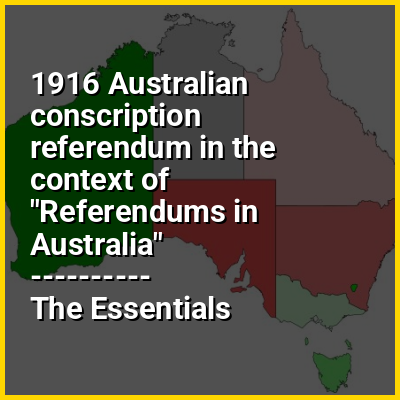
The 1916 Australian referendum, concerning how conscripted soldiers could be deployed, was held on 28 October 1916. It was the first non-binding Australian referendum (often referred to as a plebiscite because it did not involve a constitutional question), and contained one proposition, which was Prime Minister Billy Hughes' proposal to allow conscripted troops to serve overseas during World War I.

Mandatory conscription for males aged 12 to 26 had been implemented in 1911. The use of conscripted troops to fight outside Australia was contentious, although the Australian government had sufficient powers to do so. Due to the controversial nature of the measure, and a lack of clear parliamentary support, Hughes took the issue to a public vote to obtain symbolic, rather than legal, sanction for the move. It was conducted under the Military Service Referendum Act 1916. The referendum sparked a divisive debate that split the nation and resulted in a close but clear rejection of the measure. It directly resulted in the Australian Labor Party split of 1916, the expulsion of Hughes and his supporters from the ALP, and the creation of a new Nationalist Party led by Hughes. After the 1917 election resulted in the re-election of Hughes, a second referendum was held late that year, about the same issue. The government had softened the conscription conditions and simplified the wording of the conscription proposal, but it was also rejected.
↓ Menu
HINT:

In this Dossier

1916 Australian conscription referendum in the context of John Curtin

John Curtin (8 January 1885 – 5 July 1945) was an Australian politician who served as the 14th prime minister of Australia from 1941 until his death in 1945. He held office as the leader of the Australian Labor Party (ALP), having been most notable for leading the country through the majority of World War II, including all but the last few weeks of the war in the Pacific. Curtin's leadership skills and personal character were acclaimed by his political contemporaries, and he is frequently ranked as one of Australia's greatest prime ministers and political leaders.

Curtin left school at the age of 13 and became involved in the labour movement in Melbourne. He joined the Labor Party at a young age and was also involved with the Victorian Socialist Party. He became state secretary of the Timberworkers' Union in 1911 and federal president in 1914. Curtin was a leader of the "No" campaign during the 1916 referendum on overseas conscription, and was briefly jailed for refusing to attend a compulsory medical examination. He moved to Perth the following year to become the editor of the Westralian Worker, and later was state president of the Australian Journalists' Association.

View the full Wikipedia page for John Curtin
↑ Return to Menu