1844 United States presidential election in the context of "Republic of Texas"

Play Trivia Questions online!

or

Skip to study material about 1844 United States presidential election in the context of "Republic of Texas"

Ad spacer

⭐ Core Definition: 1844 United States presidential election

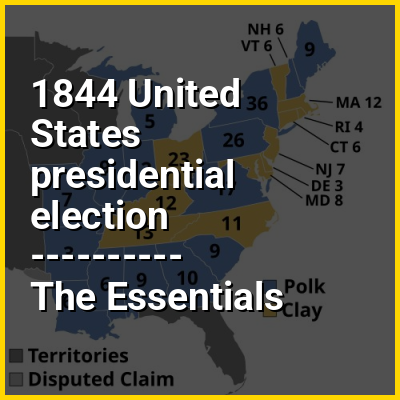
Presidential elections were held in the United States from November 1 to December 4, 1844. Democratic nominee James K. Polk narrowly defeated Whig Henry Clay in a close contest turning on the controversial issues of slavery and the annexation of the Republic of Texas. This is the only election in which both major party nominees served as Speaker of the House at one point, and the first in which neither candidate held elective office at the time.

President John Tyler's pursuit of Texas annexation divided both major parties. Annexation would geographically expand American slavery. It also risked war with Mexico while the United States engaged in sensitive possession and boundary negotiations with Great Britain, which controlled Canada, over Oregon. Texas annexation thus posed both domestic and foreign policy risks. Both major parties had wings in the North and the South, but the possibility of the expansion of slavery threatened a sectional split in each party. Expelled by the Whig Party after vetoing key Whig legislation and lacking a firm political base, Tyler hoped to use the annexation of Texas to win the presidency as an independent or at least to have decisive, pro-Texas influence over the election.
↓ Menu

>>>PUT SHARE BUTTONS HERE<<<
In this Dossier

1844 United States presidential election in the context of Mexican–American War

The Mexican–American War, also known in the United States as the Mexican War and in Mexico as the United States intervention in Mexico, (April 25, 1846 – February 2, 1848) was an invasion of Mexico by the United States. It followed the 1845 American annexation of Texas, which Mexico still considered its territory because it refused to recognize the Treaties of Velasco, signed by President Antonio López de Santa Anna after he was captured by the Texian Army during the 1836 Texas Revolution. The Republic of Texas was de facto an independent country, but most of its Anglo-American citizens who had moved from the United States to Texas after 1822 wanted to be annexed by the United States.

Sectional politics over slavery in the United States had previously prevented annexation because Texas would have been admitted as a slave state, upsetting the balance of power between Northern free states and Southern slave states. In the 1844 United States presidential election, Democrat James K. Polk was elected on a platform of expanding U.S. territory to Oregon, California (also a Mexican territory), and Texas by any means, with the 1845 annexation of Texas furthering that goal. However, the boundary between Texas and Mexico was disputed, with the Republic of Texas and the U.S. asserting it to be the Rio Grande and Mexico claiming it to be the more-northern Nueces River. Polk sent a diplomatic mission to Mexico in an attempt to buy the disputed territory, together with California and everything in between for $25 million (equivalent to $798 million in 2024), an offer the Mexican government refused. Polk then sent a group of 80 soldiers across the disputed territory to the Rio Grande, ignoring Mexican demands to withdraw. Mexican forces interpreted this as an attack and repelled the U.S. forces on April 25, 1846, a move which Polk used to convince the Congress of the United States to declare war.

↑ Return to Menu

1844 United States presidential election in the context of James K. Polk

James Knox Polk (/pk/; November 2, 1795 – June 15, 1849) was the 11th president of the United States, serving from 1845 to 1849. A protégé of Andrew Jackson and a member of the Democratic Party, he was an advocate of Jacksonian democracy and American expansionism. Polk saw Texas join the Union in his first year in office, one of the precipitating causes that soon led the U.S. into the Mexican–American War. The settlement of that war expanded American territory to the Pacific Ocean. During his term, the dispute over the Oregon Territory with the United Kingdom was also resolved, creating the present U.S.-Canadian boundary.

After building a successful law practice in Tennessee, Polk was elected to its state legislature in 1823 and then to the United States House of Representatives in 1825, becoming a strong supporter of Jackson. Following his tenure as chairman of the Ways and Means Committee, he became Speaker of the House in 1835, the only person to serve both as Speaker and U.S. president. Polk left Congress to run for governor of Tennessee, winning in 1839 but losing in 1841 and 1843. He was a dark-horse candidate in the 1844 presidential election as the Democratic Party nominee. Polk entered his party's convention as a potential nominee for vice president but emerged as a compromise to head the ticket when no presidential candidate could gain the necessary two-thirds majority. In the general election, he narrowly defeated Henry Clay of the Whig Party and pledged to serve only one term.

↑ Return to Menu

1844 United States presidential election in the context of Henry Clay

Henry Clay (April 12, 1777 – June 29, 1852) was an American lawyer and statesman who represented Kentucky in both the U.S. Senate and House of Representatives. He was the seventh House speaker as well as the ninth secretary of state. Clay unsuccessfully ran for president in the 1824, 1832, and 1844 elections. He helped found both the National Republican Party and the Whig Party. For his role in defusing sectional crises, he earned the appellation of the "Great Compromiser" and was part of the "Great Triumvirate" of Congressmen, alongside fellow Whig Daniel Webster and Democrat John C. Calhoun.

Clay was born in Hanover County, Virginia, in 1777, and began his legal career in Lexington, Kentucky, in 1797. As a member of the Democratic-Republican Party, he won election to the Kentucky state legislature in 1803 and to the U.S. House of Representatives in 1810. Clay was chosen as Speaker of the House in early 1811 and, along with President James Madison, led the United States into the War of 1812 against Great Britain. In 1814, he helped negotiate the Treaty of Ghent, which brought an end to the War of 1812, and then after the war, Clay returned to his position as Speaker of the House and developed the American System, which called for federal infrastructure investments, support for the national bank, and high protective tariff rates. During 1820, Clay helped bring an end to a sectional crisis over slavery for many years by leading the passage of the Missouri Compromise. He finished with the fourth-most electoral votes in the multi-candidate 1824–1825 presidential election and used his position as speaker to help John Quincy Adams win the contingent election held to select the president. President Adams then appointed him to the prestigious position of Secretary of State. As a result, critics alleged that the two had agreed to a "corrupt bargain".

↑ Return to Menu

1844 United States presidential election in the context of Liberty Party (United States, 1840)

The Liberty Party was an abolitionist political party in the United States before the American Civil War. The party experienced its greatest activity during the 1840s, while remnants persisted as late as 1860. It supported James G. Birney in the presidential elections of 1840 and 1844. Others who attained prominence as leaders of the Liberty Party included Gerrit Smith, Salmon P. Chase, Henry Highland Garnet, Henry Bibb, and William Goodell. They attempted to work within the federal system created by the United States Constitution to diminish the political influence of the Slave Power and advance the cause of universal emancipation and an integrated, egalitarian society.

In the late 1830s, the antislavery movement in the United States was divided between Garrisonian abolitionists, who advocated nonresistance and anti-clericalism and opposed any involvement in electoral politics, and Anti-Garrisonians, who increasingly argued for the necessity of direct political action and the formation of an anti-slavery third party. At a meeting of the American Anti-Slavery Society in May 1840, the Anti-Garrisonians broke away from the Old Organization to form the American and Foreign Anti-Slavery Society. The New Organization included many political abolitionists who gathered in upstate New York to organize the Liberty Party ahead of the 1840 elections. They rejected the Garrisonian singular emphasis on moral suasion and asserted that abolitionists should oppose slavery by all available means, including by coordinating at the ballot box.

↑ Return to Menu

1844 United States presidential election in the context of Martin Van Buren

Martin Van Buren (/væn ˈbjʊərən/ van BYOO-rən; Dutch: Maarten van Buren [ˈmaːrtə(ɱ) vɑm ˈbyːrə(n)] ; December 5, 1782 – July 24, 1862) was the eighth president of the United States, serving from 1837 to 1841. A primary founder of the Democratic Party, Van Buren held a number of prominent offices. He served as New York's attorney general and U.S. senator, then briefly as the ninth governor of New York. After joining Andrew Jackson's administration, he served as the tenth United States secretary of state, minister to the United Kingdom, and ultimately, as the eighth vice president from 1833 to 1837, after being elected on Jackson's ticket in 1832. Van Buren won the presidency in 1836 against divided Whig opponents. He lost re-election in 1840, and failed to win the Democratic nomination in 1844. Later in his life, Van Buren re-emerged as an elder statesman and an anti-slavery leader who led the Free Soil Party ticket in the 1848 presidential election.

He was born in Kinderhook, New York, where most residents were of Dutch descent and spoke Dutch as their primary language. Van Buren is the only president to have spoken English as a second language. He entered politics as a member of the Democratic-Republican Party, won a seat in the New York State Senate, and was elected to the United States Senate in 1821. As the leader of the Bucktails faction of the party, Van Buren established the political machine known as the Albany Regency. He ran successfully for governor of New York to support Andrew Jackson's candidacy in the 1828 presidential election but resigned shortly after Jackson was inaugurated so he could accept appointment as Jackson's secretary of state. In the cabinet, Van Buren was a key Jackson advisor and built the organizational structure for the coalescing Democratic Party. He ultimately resigned to help resolve the Petticoat affair and briefly served as ambassador to the United Kingdom. At Jackson's behest, the 1832 Democratic National Convention nominated Van Buren for vice president, and he took office after the Democratic ticket won the 1832 presidential election.

↑ Return to Menu

1844 United States presidential election in the context of Third party (U.S. politics)

Third party, or minor party, is a term used in the United States' two-party system for political parties other than the Democratic and Republican parties. The Electoral College for presidential elections and the plurality voting system for most other elections have established a two-party system in American politics. Third parties are most often encountered in presidential elections and while third-party candidates rarely win elections, they can have an effect on them through vote splitting and other impacts.

With few exceptions, the U.S. system has two major parties which have won, on average, 98% of all state and federal seats. According to Duverger's law two main political parties emerge in political systems with plurality voting in single-member districts. In this case, votes for minor parties can potentially be regarded as splitting votes away from the most similar major party. Third party vote splitting exceeded a president's margin of victory in three elections: 1844, 2000, and 2016.

↑ Return to Menu