1796 United States presidential election in the context of "George Washington's Farewell Address"

Play Trivia Questions online!

or

Skip to study material about 1796 United States presidential election in the context of "George Washington's Farewell Address"

Ad spacer

⭐ Core Definition: 1796 United States presidential election

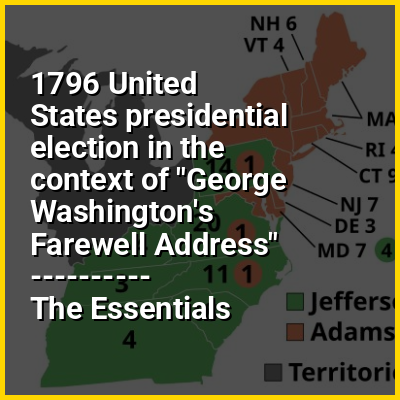
Presidential elections were held in the United States from November 4 to December 7, 1796, when electors throughout the United States cast their ballots. It was the first contested American presidential election, the first presidential election in which political parties played a dominant role, and the only presidential election in which a president and vice president were elected from opposing tickets. Incumbent vice president John Adams of the Federalist Party defeated former secretary of state Thomas Jefferson of the Democratic-Republican Party.

With incumbent president George Washington having refused a third term in office, the 1796 election became the first U.S. presidential election in which political parties competed for the presidency. The Federalists coalesced behind Adams and the Democratic-Republicans supported Jefferson, but each party ran multiple candidates. Under the electoral rules in place prior to the Twelfth Amendment, the members of the Electoral College each cast two votes, with no distinction made between electoral votes for president and electoral votes for vice president. The individual with the votes of a majority of electors became president, and the runner-up became vice president. If there was a tie for first place or no person won a majority, the House of Representatives would hold a contingent election. Also, if there were a tie for second place, the vice presidency, the Senate would hold a contingent election to break the tie.
↓ Menu

>>>PUT SHARE BUTTONS HERE<<<

👉 1796 United States presidential election in the context of George Washington's Farewell Address

Washington's Farewell Address is a letter written by President George Washington as a valedictory to "friends and fellow-citizens" after 20 years of public service to the United States. He wrote it near the end of the second term of his presidency before retiring to his home at Mount Vernon in Virginia.

The letter was first published as The Address of Gen. Washington to the People of America on His Declining the Presidency of the United States in Claypoole's American Daily Advertiser on September 19, 1796, about ten weeks before the presidential electors cast their votes in the 1796 election. In it, he writes about the importance of national unity while warning Americans of the political dangers of regionalism, partisanship, and foreign influence, which they must avoid to remain true to their values. It was almost immediately reprinted in newspapers around the country, and later in pamphlet form.

↓ Explore More Topics
In this Dossier

1796 United States presidential election in the context of 1800 United States Presidential Election

Presidential elections were held in the United States from October 31 to December 3, 1800. In what is sometimes called the "Revolution of 1800", the Democratic-Republican Party candidate, Vice President Thomas Jefferson, defeated the Federalist Party candidate and incumbent, President John Adams in the second peaceful transfer of power in the history of the United States, creating a political realignment that ushered in a generation of Democratic-Republican leadership. This was the first presidential election in U.S. history to be a rematch, the first election where an incumbent president lost re-election, leading to the first time in modern history where a national government changed hands peaceably following a free election.

Adams had narrowly defeated Jefferson in the 1796 election. Under the rules of the electoral system in place before the 1804 ratification of the Twelfth Amendment to the United States Constitution, each member of the Electoral College cast two votes, with no distinction made between electoral votes for president and electoral votes for vice president. As Jefferson received the second-most votes in 1796, he was elected vice president. In 1800, unlike in 1796, both parties formally nominated tickets. The Democratic-Republicans nominated a ticket consisting of Jefferson and Aaron Burr, while the Federalists nominated a ticket consisting of Adams and Charles Cotesworth Pinckney. Each party formed a plan by which one of their respective electors would vote for a third candidate or abstain so that its preferred presidential candidate (Adams for the Federalists and Jefferson for the Democratic-Republicans) would win one more vote than the party's other nominee.

↑ Return to Menu

1796 United States presidential election in the context of Presidency of John Adams

John Adams served as the second president of the United States from March 4, 1797, to March 4, 1801. Adams, who had served as vice president under George Washington, took office as president after winning the 1796 presidential election. The only member of the Federalist Party to ever serve as president, his presidency ended after a single term following his defeat in the 1800 presidential election. He was succeeded by Thomas Jefferson of the opposition Democratic-Republican Party.

When Adams entered office, the ongoing major European war between France and Great Britain was causing great difficulties for American merchants on the high seas and arousing intense partisanship among contending political parties nationwide. Attempts to negotiate with the French led to the XYZ Affair, in which French officials demanded bribes before they would assent to the beginning of negotiations. The XYZ Affair outraged the American public, and the United States and France engaged in an undeclared naval conflict known as the Quasi-War, which dominated the remainder of Adams's presidency. Adams presided over an expansion of the army and the navy, and the navy won several successes in the Quasi-War.

↑ Return to Menu

1796 United States presidential election in the context of Oliver Ellsworth

Oliver Ellsworth (April 29, 1745 – November 26, 1807) was a Founding Father of the United States, attorney, jurist, politician, and diplomat. Ellsworth was a framer of the United States Constitution, United States senator from Connecticut, and the third chief justice of the United States. Additionally, he received 11 electoral votes in the 1796 presidential election.

Born in Windsor, Connecticut, Ellsworth attended the College of New Jersey where he helped found the American Whig–Cliosophic Society. In 1777, he became the state attorney for Hartford County, Connecticut, and was selected as a delegate to the Continental Congress, serving during the remainder of the American Revolutionary War. He served as a state judge during the 1780s and was selected as a delegate to the 1787 Philadelphia Convention, which produced the United States Constitution. While at the convention, Ellsworth played a role in fashioning the Connecticut Compromise between the more populous states and the less populous states. He also served on the Committee of Detail, which prepared the first draft of the Constitution, but he left the convention and did not sign the document.

↑ Return to Menu

1796 United States presidential election in the context of United States presidential nominating convention

A United States presidential nominating convention is a political convention held every four years in the United States by most of the political parties who will be fielding nominees in the upcoming U.S. presidential election. The formal purpose of such a convention is to select the party's nominees for popular election as President and Vice President, as well as to adopt a statement of party principles and goals known as the party platform and adopt the rules for the party's activities, including the presidential nominating process for the next election cycle. Conventions remain an important part of the political process despite the nominees almost always being determined during the primary season, as they provide positive publicity for the nominee and party, which can then lead to a convention bounce.

The earliest public national presidential nominating Conventions have been traced back to the 1832 election, before which smaller groups of party leaders chose the nominee, arguably beginning with the 1796 election. Since 1972, most of the delegates have been selected in presidential primaries state by state. Other delegates to these conventions include political party members who are seated automatically, and are called "unpledged delegates" because they can choose for themselves for which candidate they vote. The pledged delegates determined by the primaries generally allow the nominees to be decided before the convention opens, but if no single candidate has secured a majority of both pledged and unpledged delegates then a "brokered convention" can result.

↑ Return to Menu