117th IOC Session in the context of Raffles City Singapore


117th IOC Session in the context of Raffles City Singapore

⭐ Core Definition: 117th IOC Session

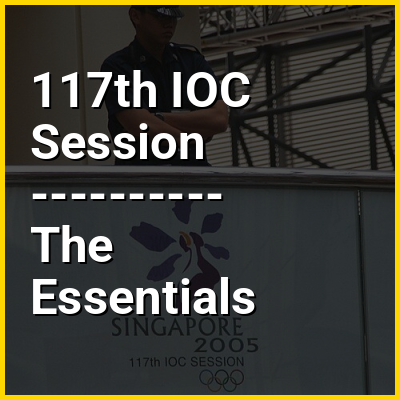
The 117th International Olympic Committee Session was held for the first time in Singapore from 2 to 9 July 2005. Two important decisions were made through voting during the session – namely the selection of the hosting city for the 2012 Summer Olympics, and a review of the 28 sports currently represented in the summer games.

The session was held at the Raffles City Convention Centre, which is on level 4 of the Raffles City complex. The opening ceremony on 5 July 2005 was held at the Esplanade – Theatres on the Bay.

↓ Menu
HINT:

In this Dossier

117th IOC Session in the context of 2012 Summer Olympics

The 2012 Summer Olympics, officially the Games of the XXX Olympiad and also known as London 2012, were an international multi-sport event held from 27 July to 12 August 2012 in London, England. Some events were held at stadiums in Glasgow, Scotland and Cardiff, Wales. The first event, the group stage in women's football, began on 25 July at the Millennium Stadium in Cardiff, followed by the opening ceremony on 27 July. There were 10,518 athletes from 206 National Olympic Committees (NOCs) who participated in the 2012 Olympics.

Following a bid headed by former Olympic champion Sebastian Coe and the then-London mayor Ken Livingstone, London was selected as the host city at the 117th IOC Session in Singapore on 6 July 2005, defeating bids from Moscow, New York City, Madrid, and Paris. London became the first city to host the modern Olympics three times, having previously hosted the Summer Games in 1908 and 1948. Construction for the Games involved considerable redevelopment, with an emphasis on sustainability. The main focus was a new 200-hectare (490-acre) Olympic Park, constructed on a former industrial site in Stratford, East London. The Games also used venues that already existed before the bid.

View the full Wikipedia page for 2012 Summer Olympics
↑ Return to Menu

117th IOC Session in the context of 2012 Summer Olympics bids

Nine cities submitting bids to host the 2012 Summer Olympics and 2012 Summer Paralympics were recognised by the International Olympic Committee (IOC). The Committee shortlisted five of them—London, Madrid, Moscow, New York City, and Paris—from which London eventually prevailed; thus becoming the first city to host the Olympic Games for a third time. The bidding process for the 2012 Olympics was considered one of the most hotly contested in the history of the IOC. Paris was seen by some as the front-runner for much of the campaign, but skillful lobbying by London's supporters and an inspirational final presentation by Sebastian Coe led to the success of its bid.

After a technical evaluation of the nine original bids, the top five were shortlisted on 18 May 2004, becoming official candidates. The remaining applicant cities—Havana, Istanbul, Leipzig and Rio de Janeiro—were eliminated. Four of the five candidate cities were prominent national capitals, which lent an increased competitive interest to the final bidding phase. Paris and Madrid earned the top scores during the application phase, but in early 2005, a more thorough evaluation of the candidates put Paris and London in a close race that became tighter as the final vote approached. On 6 July 2005, in a four-round exhaustive ballot of the IOC (gathered at the 117th IOC Session in Singapore), Moscow, New York City and Madrid were eliminated in the first three rounds. London won the final round by a margin of four votes over Paris and secured the right to host the 2012 Olympics.

View the full Wikipedia page for 2012 Summer Olympics bids
↑ Return to Menu

117th IOC Session in the context of London 2012 Olympic bid

London 2012 was the successful bid to host the 2012 Summer Olympics, held in London with most events taking place in Stratford in the borough of Newham. The British Olympic Association had been working on the bid since 1997, and presented its report to government ministers in December 2000.

Following three consecutive unsuccessful UK bids to host summer Olympic Games (Birmingham for 1992 and Manchester for 1996 and 2000), the decision was made to bid with London, given the clear indication that it was the only UK city that had a chance of being selected by the International Olympic Committee (IOC) when put up against other world cities in a competitive bidding process. On 6 July 2005 at its 117th Session in Singapore, the IOC awarded London the right to host the Games of the XXX Olympiad. The city beat the favourite Paris 54 to 50 on the fourth and final ballot. London was the first city to host the Games three times.

View the full Wikipedia page for London 2012 Olympic bid
↑ Return to Menu

117th IOC Session in the context of 2012 Olympic Games

The 2012 Summer Olympics, officially the Games of the XXX Olympiad and also known as London 2012, were an international multi-sport event held from 27 July to 12 August 2012 in London, England. Some events were held at stadiums in Glasgow, Scotland, and Cardiff, Wales. The first event, the group stage in women's football, began on 25 July at the Millennium Stadium in Cardiff, followed by the opening ceremony on 27 July. There were 10,518 athletes from 206 National Olympic Committees (NOCs) who participated in the 2012 Olympics.

Following a bid headed by the former Olympic champion Sebastian Coe and the mayor of London, Ken Livingstone, London was selected as the host city at the 117th IOC Session in Singapore on 6 July 2005, defeating bids from Moscow, New York City, Madrid and Paris. London became the first city to host the modern Olympics three times, having previously hosted the Summer Games in 1908 and 1948. Construction for the Games involved considerable redevelopment, with an emphasis on sustainability. The main focus was a new 200-hectare (490-acre) Olympic Park, constructed on a former industrial site in Stratford, East London. The Games also used venues that already existed before the bid.

View the full Wikipedia page for 2012 Olympic Games
↑ Return to Menu