0-6-0 in the context of Tank locomotive


0-6-0 in the context of Tank locomotive

⭐ Core Definition: 0-6-0

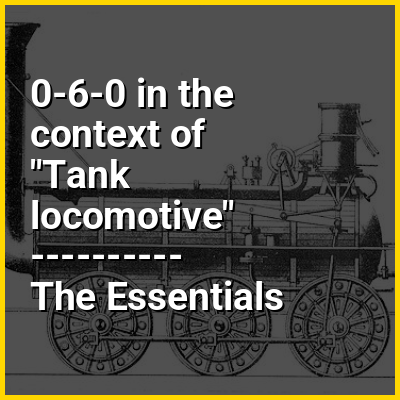
0-6-0 is the Whyte notation designation for steam locomotives with a wheel arrangement of no leading wheels, six powered and coupled driving wheels on three axles, and no trailing wheels. Historically, this was the most common wheel arrangement used on both tender and tank locomotives in versions with both inside and outside cylinders.

In the United Kingdom, the Whyte notation of wheel arrangement was also often used for the classification of electric and diesel-electric locomotives with side-rod coupled driving wheels. Under the UIC classification, popular in Europe, this wheel arrangement is written as C if the wheels are coupled with rods or gears, or Co if they are independently driven, the latter usually being electric and diesel-electric locomotives.
↓ Menu
HINT:

In this Dossier

0-6-0 in the context of H.K. Porter, Inc.

H.K. Porter, Inc. (Porter) manufactured light-duty railroad locomotives in the US, starting in 1866. The company became the largest producer of industrial locomotives, and built almost eight thousand of them. The last locomotive was built in 1950, but the company continues to produce industrial equipment to this day.

Porter was known for building locomotives for industrial railways, which were often small enough that they could be operated by one person. Porter built mostly steam locomotives, but also some gas- and diesel- engined locomotives, and some that ran on compressed air.

View the full Wikipedia page for H.K. Porter, Inc.
↑ Return to Menu