Porphyrin in the context of "Photoautotroph"

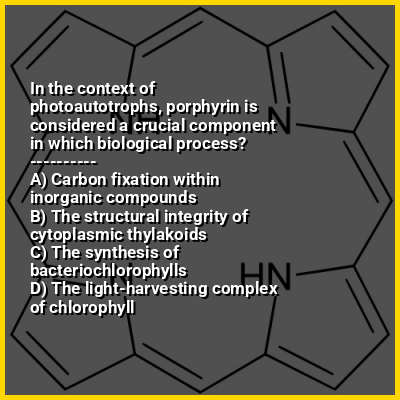
⭐ In the context of photoautotrophs, porphyrin is considered a crucial component in which biological process?


⭐ Core Definition: Porphyrin

Porphyrins (/ˈpɔːrfərɪns/ POR-fər-ins) are heterocyclic, macrocyclic, organic compounds, composed of four modified pyrrole subunits interconnected at their α carbon atoms via methine bridges (=CH−). In vertebrates, an essential member of the porphyrin group is heme, which is a component of hemoproteins, whose functions include carrying oxygen in the bloodstream. In plants, an essential porphyrin derivative is chlorophyll, which is involved in light harvesting and electron transfer in photosynthesis.

The parent of porphyrins is porphine, a rare chemical compound of exclusively theoretical interest. Substituted porphines are called porphyrins. With a total of 26 π-electrons the porphyrin ring structure is a coordinated aromatic system. One result of the large conjugated system is that porphyrins absorb strongly in the visible region of the electromagnetic spectrum, i.e. they are deeply colored. The name "porphyrin" derives from Greek πορφύρα (porphyra) 'purple'.
↓ Menu

👉 Porphyrin in the context of Photoautotroph

Photoautotrophs are organisms that can utilize light energy from sunlight, and elements (such as carbon) from inorganic compounds, to produce organic materials needed to sustain their own metabolism (i.e. autotrophy). Such biological activities are known as photosynthesis, and examples of such organisms include plants, algae and cyanobacteria.

Eukaryotic photoautotrophs absorb photonic energy through the photopigment chlorophyll (a porphyrin derivative) in their endosymbiont chloroplasts, while prokaryotic photoautotrophs use chlorophylls and bacteriochlorophylls present in free-floating cytoplasmic thylakoids. Plants, algae, and cyanobacteria perform oxygenic photosynthesis that produces oxygen as a byproduct, while some bacteria perform anoxygenic photosynthesis.

↓ Explore More Topics
In this Dossier

Porphyrin in the context of Purple Earth hypothesis

The Purple Earth hypothesis (PEH) is an astrobiological hypothesis, first proposed by molecular biologist Shiladitya DasSarma in 2007, that the earliest photosynthetic life forms of Early Earth were based on the simpler molecule retinal rather than the more complex porphyrin-based chlorophyll, making the surface biosphere appear purplish rather than its current greenish color. It is estimated to have occurred between 3.5 and 2.4 billion years ago during the Archean eon, prior to the Great Oxygenation Event and Huronian glaciation.

Retinal-containing cell membranes exhibit a single light absorption peak centered in the energy-rich green-yellow region of the visible spectrum, but transmit and reflect red and blue light, resulting in a magenta color. Chlorophyll pigments, in contrast, absorb red and blue light, but little or no green light, which results in the characteristic green reflection of plants, cyanobacteria, green algae, and other organisms with chlorophyllic organelles. The simplicity of retinal pigments in comparison to the more complex chlorophyll, their association with isoprenoid lipids in the cell membrane, as well as the discovery of archaeal membrane components in ancient sediments on the Early Earth are consistent with an early appearance of life forms with purple membranes prior to the turquoise of the Canfield ocean and later green photosynthetic organisms.

↑ Return to Menu

Porphyrin in the context of Chlorophyll c

Chlorophyll c refers to forms of chlorophyll found in certain marine algae, including the photosynthetic Chromista (e.g. diatoms and brown algae) and dinoflagellates. These pigments are characterized by their unusual chemical structure, with a porphyrin as opposed to the chlorin (which has a reduced ring D) as the core; they also do not have an isoprenoid tail. Both these features stand out from the other chlorophylls commonly found in algae and plants.

It has a blue-green color and is an accessory pigment, particularly significant in its absorption of light in the 447–520 nm wavelength region. Like chlorophyll a and chlorophyll b, it helps the organism gather light and passes a quanta of excitation energy through the light harvesting antennae to the photosynthetic reaction centre.

↑ Return to Menu

Porphyrin in the context of Macrocyclic

Macrocycles are often described as molecules and ions containing a ring of twelve or more atoms. Classical examples include the crown ethers, calixarenes, porphyrins, and cyclodextrins. Macrocycles describe a large, mature area of chemistry.

↑ Return to Menu

Porphyrin in the context of Pyrrole

Pyrrole is a heterocyclic, aromatic, organic compound, a five-membered ring with the formula C4H4NH. It is a colorless volatile liquid that darkens readily upon exposure to air. Substituted derivatives are also called pyrroles, e.g., N-methylpyrrole, C4H4NCH3. Porphobilinogen, a trisubstituted pyrrole, is the biosynthetic precursor to many natural products such as heme.

Pyrroles are components of more complex macrocycles, including the porphyrinogens and products derived therefrom, including porphyrins of heme, the chlorins, bacteriochlorins, and chlorophylls.

↑ Return to Menu

Porphyrin in the context of Hemoprotein

A hemeprotein (or haemprotein; also hemoprotein or haemoprotein), or heme protein, is a protein that contains a heme prosthetic group. They are a very large class of metalloproteins. The heme group confers functionality, which can include oxygen carrying, oxygen reduction, electron transfer, and other processes. Heme is bound to the protein either covalently or noncovalently or both.

The heme consists of iron cation bound at the center of the conjugate base of the porphyrin, as well as other ligands attached to the "axial sites" of the iron. The porphyrin ring is a planar dianionic, tetradentate ligand. The iron is typically Fe or Fe. One or two ligands are attached at the axial sites. The porphyrin ring has four nitrogen atoms that bind to the iron, leaving two other coordination positions of the iron available for bonding to the histidine of the protein and a divalent atom.

↑ Return to Menu